

What If Messi Never Left Barcelona? 5 Football Alternate Histories
Key Takeaways: The Alternate Reality at a Glance
- Financial Compromise: La Liga would have had to soften its economic controls, delaying Barcelona's aggressive asset sales.
- PSG's Culture Reset: Without Messi, Paris Saint-Germain avoids the dysfunctional superstar trio and pivots toward youth years earlier.
- The Transfer Chain: Robert Lewandowski stays in Munich or heads to the Premier League, reshaping European finishing records.
- Emotional Legacy: Fans dodge the shock exit that mirrored the pain seen in the most painful defeats in football history, earning a genuine send-off instead.
Every football supporter remembers where they stood on August 5, 2021. The club statement dropped like a sledgehammer across social feeds: Lionel Messi would not continue at FC Barcelona. We had spent months hearing that the contract extension was purely administrative, a formality waiting on signature ink.
Then, suddenly, the greatest partnership in sporting history shattered overnight over financial fair play calculations.
Messi wept into a tissue paper at his farewell press conference. Three days later, he held up a Paris Saint-Germain shirt in front of screaming crowds on the Parisian beltway. It felt wrong. It felt alien. Unlike bitter splits where stars forced moves—the infamous chaos surrounding transfer betrayals fans never forgave—this exit carried pure melancholy. Neither the player nor the match-going fans wanted it.
Now, looking back from 2026, we can see the monumental shockwaves that single afternoon sent through the entire European football landscape. But what if Joan Laporta had somehow engineered a miracle? What if Javier Tebas blinked, the Spanish wage rules flexed, and Leo stayed put in Catalonia until his twilight years?
Step through the looking glass into five alternate realities where Messi never packed his bags.
1. The Financial Tightrope: No Levers, Just Survival
To keep Messi, Barcelona would have needed an extraordinary compromise. Spanish employment law prohibited employees from accepting more than a 50 percent pay cut. Even at that discounted rate, Messi's wage would have choked Barcelona's suffocating salary limit.
So, what happens in this alternate reality?
Laporta is forced to accept the controversial CVC investment deal he vehemently rejected in real life. Tebas grants Barcelona temporary cap relief in exchange for signing onto the league-wide private equity agreement. The immediate crisis is solved, but the club ties its television rights to external investors for fifty years without the bespoke control Laporta eventually retained.
Because Messi occupies the wage ceiling, there is no blitz of summer "levers" in 2022. No massive budget surplus to buy Jules Kounde, Raphinha, or Robert Lewandowski. Instead, Barcelona relies on brutal austerity.
Xavi Hernandez arrives earlier, but he has to field an extreme hybrid team: Messi pulling the strings, flanked by academy kids thrown straight into the fire out of necessity. It produces strange, fascinating football. Some weeks they beat opponents on sheer vintage wizardry; other weeks, an overworked veteran core leaves them badly exposed against athletic European sides.
2. PSG Dodges the Galactico Trap and Mbappé Rules Paris Alone
When PSG signed Messi, they assembled what looked on paper like the most terrifying front three in football history: Neymar, Kylian Mbappé, and Lionel Messi. In reality, it turned Parc des Princes into a reality television set.
The squad balance collapsed. Midfielders ran themselves into the ground trying to cover defensive vacancies left by three forwards who rarely pressed. The Parisian dressing room fractured into linguistic camps, and the Champions League exits grew increasingly humiliating.
Take Messi out of the Parisian equation, and everything shifts:
- Mbappé becomes the undisputed center of gravity: Without sharing status with the Argentine captain, Mbappé commands total tactical authority two years earlier than he did in reality.
- Sensible midfield recruitment: Instead of allocating tens of millions in gross salary to an aging playmaker, Paris invests in athletic, hard-pressing ball-winners back in 2021.
- Neymar's isolated decline: Without his closest friend in the squad, Neymar's dissatisfaction in Paris boils over much sooner, prompting an earlier departure.
Ironically, PSG might have won their elusive European crown sooner had they never signed the greatest player to ever touch a ball. Messi's presence inadvertently trapped Paris in an outdated commercial model of brand collection over team balance.
3. The Qatar 2022 Factor: Was Catalan Comfort Better for Argentina?
One of the strongest arguments about Messi's move to Paris was that it fundamentally battle-hardened him for the 2022 World Cup. In France, stripped of his lifelong comfort zone, whistled by his own home fans, and challenged by physical Ligue 1 defending, Messi found an edge. He channeled that defiance into Doha, roaring past defenders with a ferocious, combative swagger that finally brought the World Cup home.
What if he had stayed in Barcelona?
At Camp Nou, Messi was a protected deity. He knew every blade of grass, every staff member, every referee's tendencies. In this alternate world, he avoids the jarring physical adaptation and the emotional trauma of being jeered at Parc des Princes after European collapses.
Does comfort soften him, or does it keep his body cleaner? Lionel Scaloni had already built a bulletproof Argentina structure during the 2021 Copa América in Brazil. Rodrigo De Paul and Leandro Paredes were already willing to run through brick walls on his behalf.
Messi would still have arrived in Qatar in sensational touch. But perhaps the edge is different. Without the French media constantly scrutinizing his work rate, that burning desire to prove every doubter wrong might not have reached the volcanic pitch that dismantled Croatia and outdueled France. It remains the most fascinating psychological puzzle of his career.
4. The Striker Domino Effect: Lewandowski, Haaland, and Bayern
Transfer markets are hyper-connected networks. Tug on one string in Spain, and a bell rings in Bavaria or Manchester.
In our timeline, Robert Lewandowski forced an exit from Bayern Munich in 2022 because Barcelona desperately needed an elite talisman to fill the void left by Messi. Laporta made Lewandowski the focal point of the club's sporting resurrection.
If Messi never leaves, Barcelona never calls Lewandowski's agent. What happens next?
Lewandowski either signs an uneasy contract extension in Munich or pushes for an alternative destination. Chelsea and Paris Saint-Germain were both hunting for a relentless penalty-box predator that summer. Imagine Lewandowski leading the line at Stamford Bridge during their transition phase, completely changing Chelsea's goalscoring output.
Meanwhile, Bayern Munich never experiences their chaotic post-Lewandowski panic, where they scrambled without an orthodox number nine before eventually spending over 100 million euros on Harry Kane in 2023. If Lewandowski stays in Germany through 2024, Kane stays in North London longer, or ends up at Manchester United.
The entire European center-forward market rewrites itself simply because one Argentine never cleared out his locker in Sant Joan Despí.
5. The Camp Nou Farewell and the Lamine Yamal Handover
The cruelest aspect of Messi's actual Barcelona departure was its cold, sterile conclusion. His final appearance in Blaugrana took place inside an empty, echoing stadium against Celta Vigo during pandemic restrictions. No standing ovation. No banner unfurled across the grandstand. Just an empty pitch.
In our alternate timeline, the story finishes with the operatic majesty it warranted.
Messi plays through the 2023–24 campaign as the experienced sage. As his sprint speed wanes, he transitions completely into a vintage number ten, orchestrating attacks from deep. And then comes the poetic moment: the arrival of Lamine Yamal.
Instead of Yamal carrying the terrifying burden of being labeled "the next Messi" while the club desperately seeks an identity, the teenager gets to share the grass with his idol. Messi drifts inside, draws three defenders toward the half-space, and slides an inch-perfect reverse pass to an open Yamal racing down the right flank. The torch passes not through press conferences and nostalgic video montages, but live on the pitch.
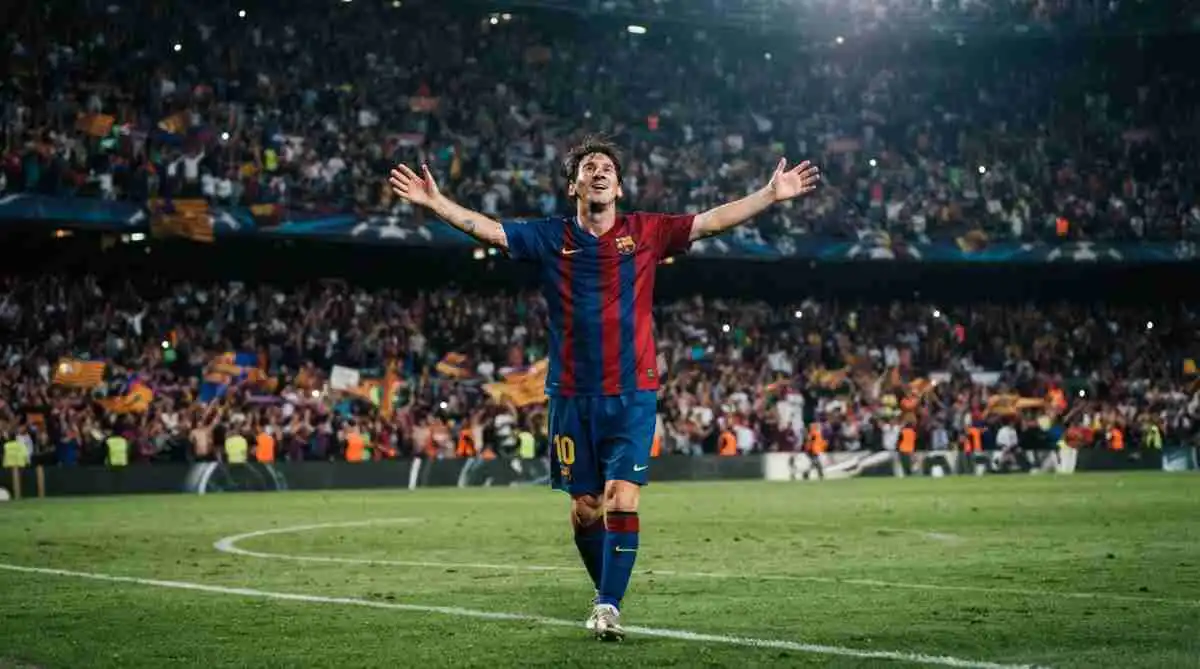
Imagine Messi's final home game in late 2024. A packed stadium, ninety thousand supporters chanting his name in unison, his children walking beside him onto the grass in tears of joy rather than despair. That alone would have healed a scar that many Barcelona socios carry to this day.
Comparing Real History vs. Alternate Barcelona Timeline
Here is how the key sporting milestones match up between what actually happened and what this alternate path would have looked like:
| Category | Real History (2021–2026) | Alternate Reality (Messi Stays) |
|---|---|---|
| Barcelona Trophy Haul | Won La Liga 2022-23 via defensive grit; European struggles in UCL group stages. | Consistent title challenger; attack mirrors the legendary chemistry seen in Barcelona 2011 vs Real Madrid 2017 comparisons. |
| PSG Tactical Trajectory | Bloated star power, early Champions League round-of-16 exits, fan unrest. | Earlier tactical balance, dynamic pressing identity built purely around Mbappé. |
| Major Striker Transfers | Lewandowski to Barcelona; Kane to Bayern Munich; Chelsea striker carousel. | Lewandowski stays in Munich or heads to London; Kane moves elsewhere. |
| Club Financial Structure | Aggressive sale of future TV and production assets (levers) to spend fast. | Severe short-term payroll cuts, heavy reliance on La Masia youth promotions. |
The Ripple That Redefined a Generation
Football history is remarkably fragile. We like to think massive clubs operate on inevitable trajectories, but often the fate of continents turns on a single legal clause, an accounting spreadsheet, or an evening phone call between an agent and a club president.
Messi leaving Barcelona was not just a player changing shirts. It was the end of football's golden romantic era, the final nail in the concept of the one-club modern superstar. While his time in Paris and his eventual adventure in North America offered brilliant spectacles, nothing ever matched the natural harmony of number ten running out from the tunnel at Camp Nou.
We missed out on an iconic farewell match, but the alternate timeline reminds us how much chaos was avoided—and created—by a single signature that never happened.
Frequently Asked Questions
Could Barcelona have legally registered Lionel Messi in the summer of 2021?
Only if La Liga had granted an unprecedented emergency salary cap exemption, or if senior captains had agreed to immediate, massive wage reductions on the spot. Under strict Spanish labor regulations, employees cannot legally take a wage cut greater than 50 percent, meaning Messi playing for free was legally impossible.
Would Lionel Messi still have won the 2022 FIFA World Cup with Argentina?
Almost certainly yes. Lionel Scaloni had already built an autonomous tactical ecosystem around him during the 2021 Copa América triumph. Staying in his familiar Catalan comfort zone might have even kept him fresher physically, avoiding the psychological wear of Parisian media scrutiny.
How would keeping Messi have affected the development of Pedri, Gavi, and Lamine Yamal?
Pedri and Gavi flourished while sharing midfield pockets with elite passers, but Lamine Yamal would likely have faced delayed integration on the right flank. Unlike many young prospects profiled among wonderkids who never made it, Yamal possessed generational talent, yet Messi occupying his exact zones would have shifted his tactical evolution.
Would Barcelona still have signed Robert Lewandowski in 2022?
No. Barcelona committed roughly 45 million euros up front plus massive recurring wages to Lewandowski precisely to replace Messi's missing 35-goal guarantee. With Messi on the payroll, Joan Laporta would never have possessed the margin or the tactical need to recruit the Polish striker.
