

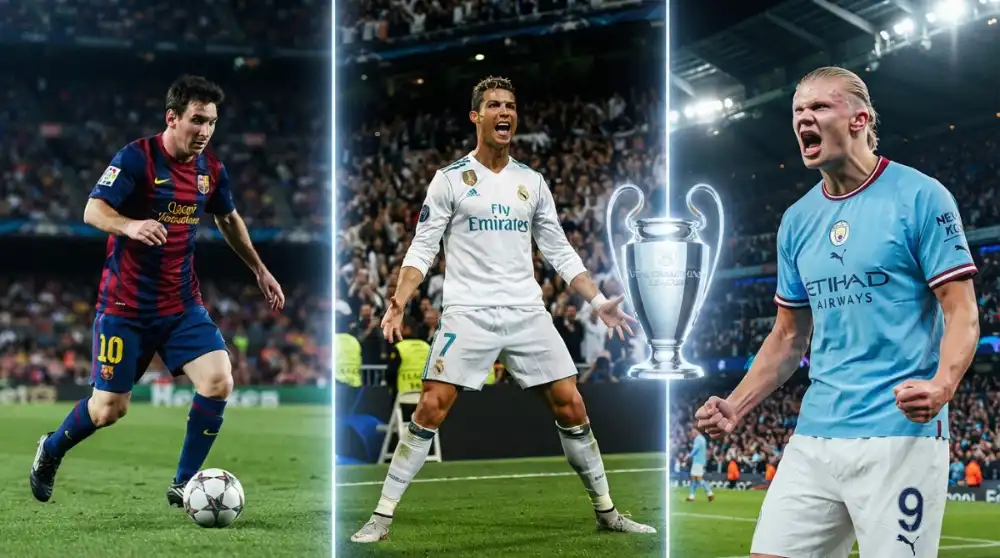
Barcelona 2011 vs Real Madrid 2017 vs Man City 2023: Which Team Would Win a Match Played in Their Prime?
Every football fan has spent late nights arguing this exact hypothetical at the pub or across noisy group chats. If you dropped the greatest sides of the 21st century onto the same immaculate pitch, who actually walks away with the win?
We are not talking about hypothetical potential or theoretical rosters on paper. We are talking about each squad at the absolute zenith of their power. The night Wembley fell silent under Barcelona’s passing carousel in May 2011. The evening Cardiff witnessed Real Madrid shred Juventus in June 2017. And that blistering Istanbul night in June 2023 when Manchester City completed their ruthless treble sweep.
These three teams did not just collect trophies. They redefined what club dominance looks like on the continent. But each operated with a radically different personality, contrasting physical dimensions, and distinct tactical philosophies.
Key Takeaways: The Prime Triad at a Glance
- Barcelona 2011: Unrivaled technical geometry, suffocation through possession, and prime false-nine Lionel Messi operating at an untouchable standard.
- Real Madrid 2017: Lethal knockout ruthlessness, devastating fullbacks, an all-time midfield trio, and the ultimate box predator in peak Cristiano Ronaldo.
- Manchester City 2023: Tactical hybridization, terrifying physical power, positional discipline, and Erling Haaland’s devastating gravity up front.
- Looking to create your own fantasy super-squad? Check out our interactive challenge to Build Your €1 Billion Dream XI and see how modern titans match up financially.
FC Barcelona 2010–11: The Peak of Positional Perfection
Watching Pep Guardiola’s 2011 side was like watching eleven musicians play an intricate symphonic piece from memory without ever missing a single note. Sir Alex Ferguson famously admitted after the 2011 Champions League final that no opponent had ever given his Manchester United side such a merciless beating.
The system functioned on pure spatial rhythm. Victor Valdes initiated moves by clipping crisp ground passes into Sergio Busquets, who acted as the calmest pivot in football history. Then came Xavi Hernandez and Andres Iniesta. Xavi governed the tempo like a metronome, turning within millimeters of opposing tacklers. Iniesta drifted past aggressive midfield pressing like smoke slipping through an open window.
Up front, David Villa and Pedro Rodriguez made constant diagonal runs to pull opposition center-backs into uncomfortable wide channels. That movement carved open a massive expanse between lines for Lionel Messi. In 2010–11, Messi scored 53 goals and assisted 24 in 55 appearances across all competitions. But raw numbers do not even tell half the story. He picked up the ball forty yards out, glided past three challenges, and threaded through-balls with laser precision.
Defensively, they were ferocious. The famous six-second pressing rule was not just a clever training drill; it was an suffocating trap. If Barca turned the ball over, Javier Mascherano, Carles Puyol, Busquets, and Dani Alves swarmed the ball-carrier before an outlet pass could even develop. You spent eighty minutes chasing phantoms, exhausted mentally and physically.
Real Madrid 2016–17: The Unrelenting Knockout Machine
If Barcelona 2011 were fine-art painters, Zinedine Zidane’s 2016–17 Real Madrid were a battering ram engineered out of titanium and swagger. This was the peak of Madrid’s historic three-peat era, and the 2016–17 squad was by far the most balanced, lethal, and tactically adaptable of the bunch.
Zidane did not get bogged down in dogmatic positional play. Instead, he organized his side to exploit every weakness the opponent revealed. At the base sat Casemiro, acting as the ultimate midfield enforcer who broke up counter-attacks and protected Sergio Ramos and Raphael Varane. Beside him, Luka Modric and Toni Kroos ran the game with effortless mastery. Kroos dictated the long switches, while Modric broke pressing lines with sudden bursts of acceleration.
The true nightmare for opponents came from the flanks. Dani Carvajal and Marcelo were not merely fullbacks; they functioned as Madrid’s primary wing playmakers. Marcelo, in particular, played like a Brazilian number ten hugging the touchline. Their pinpoint crossing constantly bombarded penalty boxes, giving Karim Benzema and Cristiano Ronaldo an endless supply of high-percentage chances.
And then there was Cristiano Ronaldo himself. In the spring of 2017, Ronaldo produced arguably the greatest Champions League knockout campaign by an individual forward: five goals across two legs against Bayern Munich, a semifinal hat-trick against Atletico Madrid, and a clinical brace against Juventus in the final. When Madrid needed a goal, they did not hope for one. They forced it into existence.
Manchester City 2022–23: The Modern Hybrid Juggernaut
Fast forward twelve years from Wembley 2011, and Pep Guardiola delivered another tactical masterpiece. But this version looked nothing like his nimble Catalan artists. Manchester City 2023 was a colossal, physically imposing machine that married pinpoint possession with unmatched athletic power.
Guardiola solved City’s transition vulnerabilities by ditching traditional fullbacks entirely. He fielded four natural center-backs: Manuel Akanji, Ruben Dias, Nathan Ake, and John Stones. Then came the masterstroke. In possession, Stones pushed forward into midfield alongside Rodri, creating an impenetrable 3-2-4-1 shape. Rodri owned the central third, while Stones gave City numerical superiority that suffocated counter-attacking channels.
Ahead of them, Kevin De Bruyne operated at peak creative brilliance, feeding deadly cutbacks and through-balls to Erling Haaland. Haaland smashed the Premier League single-season scoring record with 36 league goals and finished with 52 across all competitions. Even when Haaland did not touch the ball for fifteen minutes, his sheer presence pinned opposing center-backs twenty yards deeper than they wanted to defend.
That deep defensive positioning created massive pockets for Ilkay Gundogan, Jack Grealish, and Bernardo Silva to recycle possession and orchestrate patient, demoralizing attacks. When evaluating all-time dominant English campaigns, City’s historic treble run naturally sparks debates alongside our deep dive on Arsenal’s Invincibles vs Liverpool 2019 vs Man City 2023: The Greatest Premier League Team Ever. City in 2023 proved that elite technical possession could be fortified with sheer physical mass.
Direct Matchup 1: Barcelona 2011 vs Real Madrid 2017
This is the ultimate clash of styles. We saw real-life previews of this rivalry during the chaotic Mourinho-Guardiola Clasicos, but Zidane’s 2017 side was far more composed in possession than Mourinho’s fiery 2011 Madrid.
In this mythical matchup, Barcelona would unquestionably hold 62% to 65% of the ball. Modric, Kroos, and Casemiro were elite, but nobody out-possessed Xavi, Iniesta, and Busquets on flat grass. Madrid’s plan would center on soaking up pressure, compressing the central space between Casemiro and the defensive line, and unleashing sudden transitions.
The decisive battle happens out wide. Dani Alves pushed so aggressively forward that he left huge expanses of grass behind him. If Marcelo and Cristiano Ronaldo broke through that left flank against Mascherano, Madrid could score in two touches. Ronaldo in 2017 was the deadliest box finisher in world football; he did not need sustained possession, just one inch of separation from Puyol.
But Barcelona holds the ultimate trump card. Real Madrid’s fullbacks pushed high up the pitch, which frequently left Casemiro isolated against fluid runners. Messi dropping deep into the false-nine pocket dragged Ramos out of position, allowing Pedro and Villa to slice into the channels. While Madrid could definitely hurt Barca on set pieces and direct counters, Barcelona’s control of the middle would eventually wear down Madrid’s defensive shape across ninety minutes.
Direct Matchup 2: Barcelona 2011 vs Manchester City 2023
Pep versus Pep. The football romantic against the tactical pragmatist. This hypothetical tactical battle is genuinely fascinating because Guardiola built the 2023 City side specifically to survive against modern pressing engines.
City’s primary advantage here is raw physical size. Look across their starting eleven: Dias, Stones, Rodri, Haaland, Akanji, and Ake. On corner kicks and dead-ball deliveries, Barcelona would be at a massive height and power disadvantage. Pique and Busquets had height, but the rest of Barca’s core was under five-foot-nine. City could punish Barca heavily on set pieces.
However, City’s defensive setup presents serious risks against 2011 Barca. City defended transitions with a back three supported by Rodri and Stones. But can a backline containing Manuel Akanji and Nathan Ake handle prime Lionel Messi running at full speed in open space? Absolutely not. Messi back then routinely danced through entire squads of elite defenders.
Furthermore, City in 2023 occasionally struggled against sides capable of playing around Rodri’s pressing angle. Iniesta and Xavi possessed the quickest one-touch combination play in football history. If City stepped up aggressively to press, Barca’s midfield triangles would bypass them, leaving Haaland isolated sixty yards away from the action.
Direct Matchup 3: Real Madrid 2017 vs Manchester City 2023
This would be an absolute heavyweight slugfest with chaotic swings in momentum. City would aim for control through long sequences of possession, pinning Madrid deep inside their own defensive third with Gundogan, Silva, and Grealish.
The tactical rub for City is that Madrid in 2017 loved being pinned back. They never panicked. Keylor Navas made clutch saves, Ramos threw his body in front of shots, and the moment the ball landed at Kroos’s feet, Madrid transformed into an arrow. Kroos would hit an early diagonal ball to Marcelo, who would instantly cross for Ronaldo or Benzema against City’s isolated central defenders.
On the flip side, Madrid’s back four struggled with discipline against intricate cutbacks. Kevin De Bruyne slipping passes between Carvajal and Varane for Haaland to attack would produce guaranteed high-danger opportunities. Haaland against Ramos in their absolute primes would be an all-time physical war, full of shirt-pulling, aerial collisions, and high drama.
Yet Madrid possessed an aura of inevitability in 2017. When matches turned chaotic, City’s structure occasionally wobbled, whereas Zidane’s Madrid flourished in pure chaos.
Tactical Comparison Grid
| Team & Era | Tactical Blueprint | Signature Strengths | Vulnerable Blindspot | Decisive Superstar |
|---|---|---|---|---|
| Barcelona 2010–11 | 4-3-3 with false nine and rapid 6-second counter-pressing traps. | Unrivaled possession retention, spatial domination, midfield rhythm. | Defending aerial set-pieces; space behind advancing fullbacks. | Lionel Messi (53 goals, 24 assists) |
| Real Madrid 2016–17 | 4-3-1-2 diamond / 4-3-3 hybrid with marauding fullbacks. | Ruthless knockout composure, crossing variety, transition lethality. | Susceptible to sustained possession between lines when fullbacks push up. | Cristiano Ronaldo (42 goals in 46 games) |
| Man City 2022–23 | 3-2-4-1 in possession with John Stones pivoting alongside Rodri. | Dominant physical height, positional choking, generational target forward. | Vulnerable to lightning-fast direct counter-attacks into wide channels. | Erling Haaland (52 goals in 53 games) |
The Ultimate Showdown: Who Actually Wins?
If you placed all three squads into a mini round-robin tournament at a neutral venue like the Santiago Bernabeu or Wembley Stadium with every player fully rested, here is how the results shake out.
Manchester City 2023 would inflict serious physical damage on Barcelona 2011. Haaland would win his fair share of aerial duels, and De Bruyne’s wicked deliveries would cause sheer panic. But City’s defensive structure relied on controlling territory through rigid positional discipline. And against prime Lionel Messi, rigid structure always melted away. Messi in 2011 was simply too quick, too evasive, and too inventive for an inverted defensive system to contain over ninety minutes.
Real Madrid 2017 would present an even bigger threat to Barcelona because Zidane’s squad possessed an unnatural psychological confidence. They would score against Barca through Ronaldo’s aerial dominance or a Marcelo thunderbolt. But over a full match, Barcelona’s midfield trio would inevitably starve Madrid of the ball for fifteen-minute stretches, sapping the energy out of Kroos and Modric.
Against Manchester City, Real Madrid would likely edge a thrilling, end-to-end spectacle thanks to their knockout ruthlessness and Ronaldo’s clutch finishing when games get open.
So, who takes home the mythical trophy? It has to be Barcelona 2010–11. They did not merely beat great teams; they dismantled them mentally by denying them possession of the football. When you cannot touch the ball, you cannot attack. And when the ball finally lands at the feet of prime Lionel Messi, your fate is sealed.
Frequently Asked Questions
Could any midfield in history match Busquets, Xavi, and Iniesta at their peak?
The Casemiro-Kroos-Modric trio came closest in sustained European silverware, matching them in press resistance and transition speed. But for pure territorial control and ball retention, nobody has ever dictated tempo like Barcelona's 2011 midfield triad. For more classic theoretical clashes, explore our breakdown of what if Messi never left Barcelona and its impact on modern dynasties.
How would 2011 Barcelona deal with Erling Haaland's physical size and direct runs?
Gerard Pique and Javier Mascherano were not the most physically imposing central pairing, but Pep's defensive structure relied on suffocating the pass supply at the source through relentless counter-pressing rather than engaging in physical wrestling matches inside the box.
What gave Real Madrid 2017 such an unbelievable edge in one-off knockout matches?
Zinedine Zidane's Madrid possessed superhuman mental composure under pressure, elite crossing accuracy from Dani Carvajal and Marcelo, an imperious engine room, and prime Cristiano Ronaldo finishing almost every half-chance in the penalty box.
Why didn't Pep Guardiola play the exact same system at Manchester City in 2023 as he did at Barcelona in 2011?
European football evolved into a much faster, more athletic transition game by 2023. Guardiola adapted by introducing hybrid central defenders like John Stones pushing into midfield, pairing technical domination with sheer physical height and power.
Explore Further Football Deep Dives
Love historic football debates, heartbreaking finals, and squad breakdowns? Check out these related features on our site:
- Relive football heartbreaks: The Most Painful Defeats in Football History and the Fans Who Never Recovered
- Discover more in-depth editorial breakdowns across the continent on the FootballPress Home.
