

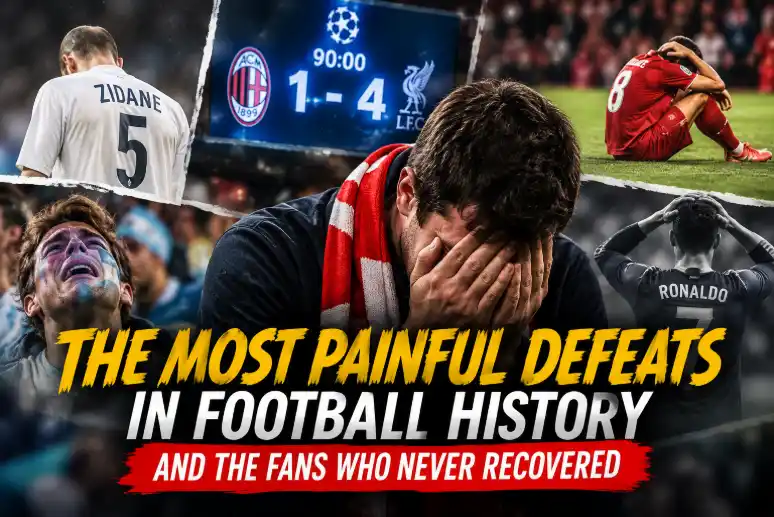
The Most Painful Defeats in Football History and the Fans Who Never Recovered
Key Takeaways
- Trauma in football is distinct from ordinary disappointment; it shatters an assumed destiny in a matter of minutes.
- The psychological toll can rewrite an entire nation's collective psyche, as shown by Brazil in both 1950 and 2014.
- Tactical paralysis usually accompanies these moments, where seasoned legends freeze under sudden, claustrophobic pressure.
- Supporters pass down the memory of these disasters like family heirlooms, refusing to let the wound fully close.
- For comprehensive analysis and long-form coverage of the beautiful game, check our home base at FootballPress.
Every football supporter carries an invisible ledger of sorrow. You can ask an eighty-year-old grandfather in Rio de Janeiro, a middle-aged Milanese accountant, or a teenager walking out of the Parc des Princes, and they will all pinpoint the exact minute their sporting innocence died. They remember what the weather felt like. They remember who was sitting next to them on the sofa or the damp plastic stadium seat. Most painfully, they remember the terrifying numbness that set in when the impossible went from bad dream to cold reality.
Football sells hope with unmatched potency. That is why its sudden betrayals feel so personal, almost physical. When your club or your country collapses on the grandest stage, the world does not just stop; it feels as though the ground drops out entirely. You watch twenty-two men chasing a ball, yet you feel like someone vandalized your living room.
We celebrate the heroic comebacks constantly. Documentaries get produced, autobiographies are penned, and statues are erected outside arenas. But what about the other side of that equation? What happens to the supporters on the wrong end of history? Those souls do not simply pack away their scarves and sleep soundly. Some defeats linger for years. Others stain generations, reshaping the cultural DNA of entire fanbases forever.
The Mineirazo: Brazil 1-7 Germany (Belo Horizonte, 2014)
To understand the depth of the Mineirazo, you must grasp what the 2014 World Cup meant to Brazil. It was supposed to be the great spiritual exorcism. Ever since 1950, when Uruguay stole the Jules Rimet trophy from the Maracana, Brazilian football had lived with an underlying anxiety. Hosting the tournament sixty-four years later was designed to heal that ancestral fracture. The country was in social turmoil, the stadiums were wildly expensive, and the pressure on Luiz Felipe Scolari's squad was suffused with political weight.
Then came the semi-final in Belo Horizonte. Neymar was injured, Thiago Silva was suspended, but nobody predicted an existential massacre. Between the 23rd and 29th minutes, the earth stopped spinning. Thomas Müller, Miroslav Klose, Toni Kroos, and Sami Khedira took turns passing into an empty net while David Luiz wandered around the pitch looking like a man lost in a blizzard.
The cameras panned to the stands, and the images became indelible instantly. Children weeping openly while eating hot dogs. Grown men clutching plastic replica trophies in hollow disbelief. An elderly man hugging a golden cup with tears running down his weathered cheeks. It was not anger; it was an acute spiritual evacuation.
German players admitted years later that they agreed at halftime to tone down their celebrations to avoid humiliating their hosts further. That restraint almost made it worse. Brazil had not just lost a semi-final; their self-anointed status as the spiritual caretakers of the sport was torn to pieces before an audience of over one billion people. Brazilian fans will tell you that the national team has never truly felt the same since that overcast afternoon.
Istanbul 2005: AC Milan's Six Minutes of Purgatory
If you want to witness how supreme arrogance collides with sheer sporting chaos, you watch the 2005 Champions League final in Istanbul. AC Milan walked onto the pitch at the Ataturk Olympic Stadium with one of the most absurdly talented starting elevens ever assembled. Dida, Cafu, Nesta, Stam, Maldini, Pirlo, Gattuso, Seedorf, Kaka, Shevchenko, Crespo. That was not a team; it was a museum of footballing royalty.
By the break, Milan were up 3-0. They had not just beaten Liverpool in that first half; they had conducted a masterclass that felt like modern art. Crespo's dink over Jerzy Dudek off Kaka's sweeping pass remains one of the sweetest goals ever scored in a European final. In the stands, the Italian supporters were already calling relatives back home, planning street parties in the Piazza del Duomo.
Then, six minutes altered history. Steven Gerrard looped a header, Vladimir Smicer fizzed a daisy-cutter from distance, and Xabi Alonso slammed home the rebound from his saved penalty. In three hundred and sixty seconds, Milan's invincible fortress melted like cheap ice cream under the Turkish night sky.
Generations of fans still talk about only 90s and 2000s kids remember these football moments with vivid clarity, but for Milan fans, this night was pure horror. Dudek made a double save against Shevchenko from two yards out during extra time that defies physics to this very day. When Shevchenko missed the decisive spot-kick in the shootout, thousands of Milan fans stood frozen in silence. They did not shout. They did not throw things. They simply stared at the grass, trying to comprehend how a squad filled with Ballon d'Or winners and World Cup champions could evaporate in less time than it takes to boil an egg.
Milan took revenge two years later in Athens, winning 2-1 against Liverpool. But ask any hardcore Rossoneri supporter: Athens felt like relief, not cure. Istanbul left a jagged mark that remains sensitive to the touch twenty years later.
Camp Nou 1999: Two Corners That Broke Bavaria
Football can be remarkably cruel in how it delivers hope right before pulling the lever on the trapdoor. The 1999 Champions League final between Bayern Munich and Manchester United was practically decided. Mario Basler had bent in an early free-kick, and for the following eighty-four minutes, the German champions controlled proceedings with icy efficiency.
Carsten Jancker hit the crossbar with an overhead kick. Mehmet Scholl chipped the ball over Peter Schmeichel only to see it clatter off the post. Bayern's captain, the great Lothar Matthaus, was substituted late in the game, looking relaxed, basking in the glow of the only major trophy that had eluded his sparkling career. Ribbons in Bayern's colors were already being tied to the trophy handles behind the touchline.
Three minutes of stoppage time changed everything. Teddy Sheringham steered home an equalizer off a scuffed shot. Before Bayern could regroup or even catch their breath, another corner flew in, Sheringham flicked it on, and Ole Gunnar Solskjaer poked the ball into the roof of Oliver Kahn's net.
Samuel Kuffour beat the turf with his fists, sobbing uncontrollably. Oliver Kahn stood motionless, staring blankly into the Catalan sky like a gargoyle. Thousands of traveling Bayern supporters were reduced to tears within ninety seconds. It was a loss so abrupt, so brutally concentrated, that it left a permanent phantom ache in Bavarian football culture. Bayern bounced back to win the title in 2001, but the phrase "Camp Nou '99" still induces shivers among veteran season-ticket holders.
The Original Wound: Brazil 1-2 Uruguay (1950)
Before the Mineirazo, there was the Maracanazo. It remains the original measuring stick for sporting grief. On July 16, 1950, nearly two hundred thousand spectators squeezed into the newly minted Maracana. Brazil only needed a draw in the final round-robin match against little Uruguay to lift their maiden World Cup.
Newspapers had printed editions declaring Brazil world champions before kickoff. Politicians delivered congratulatory speeches over loudspeakers before a single pass was completed. The carnival had already kicked off across the entire city of Rio.
Friaca put Brazil ahead early in the second half, and the stadium erupted into an earthquake of noise. But Uruguay had no intention of participating in someone else's coronation. Juan Alberto Schiaffino equalized, and then, in the 79th minute, Alcides Ghiggia broke down the right wing. Goalkeeper Moacir Barbosa anticipated a cross, took half a step away from his post, and Ghiggia squeezed the ball between Barbosa and the upright.
Ghiggia later said: "Only three people have ever silenced the Maracana: Frank Sinatra, Pope John Paul II, and me."
When the final whistle sounded, the silence was so deafening that journalists described hearing people crying blocks away from the stadium. The loss led to suicides, national mourning, and a vicious scapegoating of Barbosa, who lived the rest of his life as an outcast in his own homeland. Brazil even abandoned their traditional white kits with blue collars, switching to the iconic yellow and green jerseys because the white ones were deemed cursed by tragedy.
The Remontada and the Anfield Meltdown: Barcelona and PSG
Modern football has its own specialized laboratory of pain, centered squarely on the modern European knockout stages. In 2017, Paris Saint-Germain dismantled Barcelona 4-0 at the Parc des Princes. It was supposed to be the arrival of the French club among Europe's absolute aristocracy.
Three weeks later at Camp Nou, PSG froze. Barcelona scrapped their way to a 3-0 lead, but when Edinson Cavani smashed home an away goal, the tie looked dead. Barcelona needed three goals in less than thirty minutes. In the 88th minute, they still needed three goals. What followed was an implosion of epic proportions. Neymar scored a free-kick, converted a contentious penalty, and chipped a delicate pass for Sergi Roberto to volley home in the 95th minute. PSG fans went from the peak of European validation to the laughingstock of the continent within seven surreal minutes.
Yet, karma in football has an ironic sense of humor. Barcelona supporters, intoxicated by their miracle against PSG, would soon taste the exact same venom twice. First in 2018 against Roma, blowing a 4-1 lead in the Italian capital. Then came the nightmare at Anfield in 2019.
Leading 3-0 from the first leg, Lionel Messi's Barcelona arrived in Liverpool expecting to stroll into the final. Instead, Jurgen Klopp's men created an emotional cauldron that swallowed the Catalan giants whole. Divock Origi and Georginio Wijnaldum ran riot, culminating in Trent Alexander-Arnold's quick corner that caught Barcelona's entire defense looking at the turf. Barcelona supporters watched their golden generation fracture in real time, a mental breakdown that sparked years of financial panic and sporting mediocrity.
Anatomy of Heartbreak: Comparing History's Bitterest Losses
To put these collective traumas into perspective, we have mapped out how these historic collapses compare in their emotional velocity, tactical causes, and the lasting baggage they left behind.
| Fixture & Year | The Scoreline | Crucial Turning Point | Tactical / Mental Cause | Generational Aftermath |
|---|---|---|---|---|
| Brazil vs Uruguay (1950) | 1-2 | Ghiggia's 79th-minute strike near the near post | Premature celebrations; paralyzing home expectation | National mourning; permanent kit change from white to canary yellow |
| Bayern Munich vs Man United (1999) | 1-2 | Sheringham's 91st-minute equalizer from a corner | Failure to kill off chances; defensive relaxation late | Psychological scarring, resolved only by their 2001 redemption |
| AC Milan vs Liverpool (2005) | 3-3 (2-3 pens) | Gerrard's looping header sparking a 6-minute blitz | Sudden complacency; inability to stem emotional momentum | Considered the most devastating blown final in European history |
| Brazil vs Germany (2014) | 1-7 | Four German goals conceded inside six brutal minutes | Total structural disintegration without Neymar and Silva | Shattered Brazil's mythical aura as the unbeatable football empire |
| Barcelona vs PSG (2017) | 6-1 (6-5 agg) | Sergi Roberto's 95th-minute lunging finish | Excessive timidity by PSG; complete midfield retreat | Created the term "Remontada" and sent PSG into an identity crisis |
| Liverpool vs Barcelona (2019) | 4-0 (4-3 agg) | Alexander-Arnold's clever "corner taken quickly" | Total lack of defensive alertness; lingering Roma PTSD | Accelerated the collapse of the Bartomeu era at Barcelona |
Why the Pain Never Truly Evaporates
Why do we hold on to these agonizing afternoons? Why do grown adults still wince when an old highlight pops up on their social media feed? Sports psychologists point to the concept of parasocial investment. When you spend thousands of hours following an institution, investing hard-earned wages, traveling across continents, and tying your weekend happiness to eleven strangers, their failures feel like your personal failures.
There is also the element of irreversible narrative. A league match lost on a chilly Tuesday in November can be overturned by a hot streak in the spring. But a tournament knockout or a cup final is final. The curtain comes down, the medals are handed out, and history hardens like wet cement. You cannot replay the 93rd minute in Lisbon when Sergio Ramos headed home to steal Atletico Madrid's first European crown. You cannot undo the studs of a defender slipping at Anfield.
The beauty and tragedy of this sport are twin sisters born from the exact same passion. Without the agonizing depths of Istanbul, the euphoria of Liverpool's triumph would not resonate across generations. Without the ghosts of Belo Horizonte, German efficiency would not look as merciless as it did. Defeat is the dark shadow that gives football's triumphant moments their blinding brilliance.
Explore Further From Our Archive
- Rethink football's pivotal turning points in what if Messi never left Barcelona 5 football alternate histories.
- Discover the bitterest roster departures in transfer betrayals fans never forgave: Figo, Tevez, Ashley Cole and more.
- Compare generational dominance in our debate on Barcelona 2011 vs Real Madrid 2017 vs Man City 2023: which team would win a match played in their prime.
Frequently Asked Questions
Why is Brazil's 7-1 loss to Germany considered more traumatic than the 1950 Maracanazo?
The Maracanazo carried intense social shock because Brazil was poised to claim its first crown, but the Mineirazo in 2014 was a live global humiliation. Conceding four goals in six minutes shattered Brazil's mythical football identity on home turf in front of hundreds of millions watching in high definition.
Did AC Milan players actually celebrate at halftime during the 2005 Champions League final?
Rumors long circulated that Milan players opened champagne at the break, but key figures like Paolo Maldini and Gennaro Gattuso vehemently denied it. The locker room was focused, yet Liverpool's raucous support singing You'll Never Walk Alone shifted the psychic momentum before the restart.
Can football supporters ever genuinely recover from a traumatic loss?
Redemption helps soften the sting, but true sports trauma lingers permanently. Bayern fans eventually celebrated the 2001 Champions League, yet bringing up 1999 still stirs a visceral grimace. Generational defeats become part of a club's folklore, worn like an unhealed scar.
What tactical flaw caused PSG's 6-1 collapse against Barcelona in 2017?
Unai Emery set up Paris Saint-Germain in an uncharacteristically timid low block, inviting relentless Barcelona pressure. PSG completed only four passes between the 85th minute and the final whistle, completely freezing under emotional strain and Camp Nou noise.
