

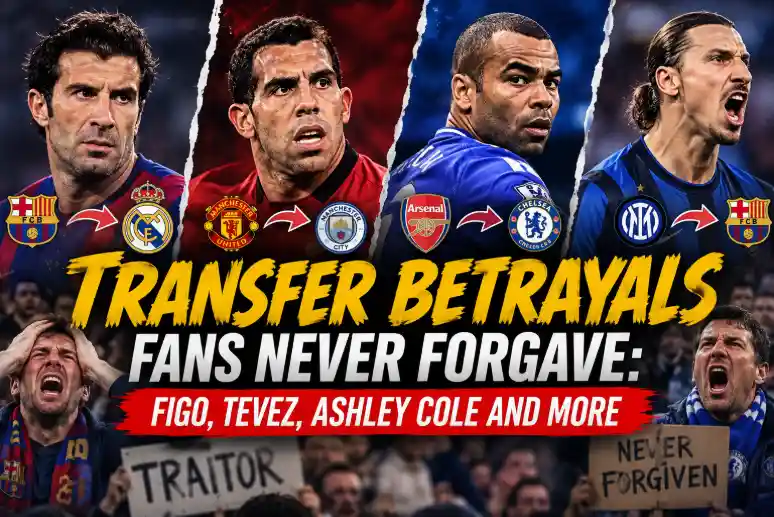
Transfer Betrayals Fans Never Forgave: Figo, Tevez, Ashley Cole and More
Key Takeaways
- Transfer betrayals are not about career choices; they strike at identity, broken promises, and communal trust.
- Luís Figo, Sol Campbell, and Ashley Cole remain cautionary tales of how commercial ambition collides violently with terrace culture.
- Trophies rarely soothe the rage of abandoned fanbases, even decades down the road.
- Curious about past eras? Check out how only 90s and 2000s kids remember these football moments when loyalty still felt unconditional.
Football supporters will forgive a missed penalty. They will forgive a relegation battle, a terrible signing, or a bad tactical blunder by an embattled manager. But cross town to sign for the sworn enemy, and you erase every good deed you ever produced in the shirt.
You can win Champions Leagues, collect golden boots, and enter retirement with bulging trophy cabinets. None of it cleanses the slate. Because when a footballer kisses the club crest on Sunday and signs on the dotted line for the bitter rival on Thursday, something primal snaps in the terrace soul.
Looking back at the timeline of European football, certain moves broke through ordinary sports rivalry and mutated into genuine hatred. Here are the transfer betrayals that fans never forgave—and never will.
Luís Figo: The Pig's Head Derby and the Price of Ambition
Nothing in modern sporting folklore matches the toxic temperature of the Camp Nou on November 23, 2002. Two years had passed since Luís Figo swapped Barcelona for Real Madrid, yet the hatred had only fermented into something deeper and more dangerous.
Figo was not merely an exceptional winger for Barcelona. He was their leader, the heart of the squad, and a cultural icon in Catalonia who had famously shouted anti-Madrid chants from the balcony of the Generalitat Palace. And then came Florentino Pérez's Galáctico masterplan in the summer of 2000.
Pérez struck a pre-election pact with Figo's representative. Figo denied the rumors repeatedly in the press, swearing his heart belonged to Barça. But when Pérez won the Madrid presidency, the buyout clause was paid. Figo showed up in the Spanish capital holding a pristine white jersey, looking like a hostage caught in his own financial trap.
When he returned to Barcelona, the reception was feral. Counterfeit banknotes bearing his face flooded the stands. Banners called him a mercenary and a traitor. Every corner kick brought a rain of lighters, mobile phones, whiskey bottles, and, most famously, a suckling pig's head tossed onto the grass. Figo won the Ballon d'Or and the European Cup in Madrid, but in Barcelona, his name remains an eternal curse.
Sol Campbell: North London's Unforgiven Secret
If Figo's exit was explosive, Sol Campbell's move in the summer of 2001 was surgical espionage. Tottenham supporters did not just love Campbell; they built their entire defensive identity around their homegrown captain.
Campbell spent over a decade at White Hart Lane. He was a pillar of stability during an era where Spurs frequently struggled to challenge the league leaders. His contract was ticking down, and Europe's biggest clubs were queuing up. Campbell conducted interviews assuring fans that he would never join Arsenal. He said it plainly, on camera, multiple times.
Then came the infamous July press conference. Journalists had gathered at London Colney expecting Arsenal to unveil backup goalkeeper Richard Wright. Instead, Arsène Wenger walked out alongside a grinning Sol Campbell. Arsenal had secured Tottenham's captain on a free transfer without a single leak reaching the press.
Spurs fans felt gutted. The nickname "Judas" was born that morning and has not softened twenty-five years later. Campbell went on to anchor Arsenal's historic unbeaten campaign—a milestone immortalized in discussions around whether that squad ranks as the greatest team ever assembled—yet Tottenham supporters never stopped chanting his name in pure derision.
Ashley Cole: The Petrol Station Meltdown and "Cashley"
Sometimes betrayal is about where you go. Other times, it is about how petty you sound while doing it. Ashley Cole managed both in the summer of 2006.
Cole was Arsenal through and through. An academy graduate, an elite left-back, and an integral component of the Invincibles. But Roman Abramovich's billionaire revolution across London at Chelsea was reshaping English football's financial reality, and Cole's eyes began to wander.
The scandal erupted when Cole was caught having an illicit meeting with Chelsea manager José Mourinho and chief executive Peter Kenyon at a London hotel. The Premier League handed out fines for tapping up, but the relationship between player and club had already rotted away.
The final straw arrived in Cole's autobiography, where he described driving his car while speaking to his agent about Arsenal's latest contract offer of £55,000 per week. Cole wrote that he was "trembling with anger" and nearly swerved off the road because Arsenal were "taking the piss."
To ordinary supporters working grueling week shifts to buy match tickets, hearing a young millionaire throw a tantrum over an extra five grand was repulsive. When he finally signed for Chelsea, Arsenal fans printed twenty-pound notes with Cole's face and dubbed him "Cashley." Cole filled his mantle with Premier League and Champions League medals, but Highbury and the Emirates permanently revoked his hero card.
Carlos Tevez: The Billboard That Ignited Manchester
Carlos Tevez always ran like a street fighter, and Manchester United supporters loved him for it. From 2007 to 2009, Tevez formed a ferocious attacking trio alongside Wayne Rooney and Cristiano Ronaldo, helping United capture back-to-back league titles and the European crown.
Yet behind the scenes, tension simmered between Tevez, his representatives, and Sir Alex Ferguson. Tevez felt undervalued and underplayed. Ferguson hesitated over paying the permanent transfer fee required to keep him at Old Trafford.
Enter Manchester City, newly bankrolled by the Abu Dhabi United Group and hungry to disrupt the established hierarchy. City paid the fee, handed Tevez the keys to their attack, and immediately went on the psychological offensive.
The club erected a towering sky-blue billboard in Manchester city center with a picture of Tevez and the words: "Welcome to Manchester." Ferguson was furious, famously branding City the "noisy neighbors."
United supporters felt punched in the stomach. When Tevez scored against United in the League Cup and taunted the bench, the bridge was torched beyond repair. Later, during City's title parade, Tevez held up a banner reading "R.I.P. Fergie." United fans responded by burning his replica shirts in pub parking lots. The love affair was dead.
Comparing Football's Most Notorious Betrayals
Every cross-rival transfer has its own flavor of chaos. Some players left for cold hard cash, others sought elusive trophies, and a few simply wanted to stick a dagger in their former board's back.
| Player | From → To | Year | The Trigger Point | Terrace Reaction |
|---|---|---|---|---|
| Luís Figo | Barcelona to Real Madrid | 2000 | Secret buyout pact with Florentino Pérez | Whiskey bottles, fake cash, suckling pig head |
| Sol Campbell | Tottenham to Arsenal | 2001 | Free transfer after promising to stay | Branded "Judas", decades of hostile chants |
| Ashley Cole | Arsenal to Chelsea | 2006 | Secret hotel meeting and contract whining | "Cashley" banknotes waved at every derby |
| Carlos Tevez | Man United to Man City | 2009 | "Welcome to Manchester" billboard campaign | Jersey bonfires and vitriolic derby atmosphere |
Why Time Doesn't Heal These Scars
You often hear that time softens all grudges in football. But that cliché rarely holds up when you walk outside real grounds. When you look closely at these four transfers, distinct patterns reveal why the anger never fades:
- The badge kissing syndrome: Every one of these players performed grand demonstrations of love for the home crowd shortly before bolting for the exit. Hypocrisy stings infinitely worse than simple departures.
- The zero-compensation gut punch: Moves like Sol Campbell leaving on a Bosman free meant Tottenham received zero transfer funds to rebuild, amplifying the insult into financial injury.
- Direct silverware consequences: These players did not move to neutral leagues abroad; they instantly handed championship titles directly to their former club's fiercest tormentors.
- The public mockery factor: Whether it was Carlos Tevez holding up offensive parade signs or Ashley Cole publishing car-swerving rants, the lack of tact cemented their reputations as villains.
Football isn't purely about cold corporate efficiency. It operates on passion, shared community heritage, and mutual trust. When players treat that bond like an easily discarded napkin, they sacrifice their legacy forever.
Explore Further on Football History
- Step into alternate timelines with our breakdown on what if Messi never left Barcelona and how European dominance could have shifted.
- Relive the heartbreak in our chronicle of the most painful defeats in football history and the fans who never recovered.
- Discover the forgotten phenoms who burned out too early in wonderkids who never made it and where they are now.
Frequently Asked Questions
Why is Luís Figo's transfer to Real Madrid considered the biggest betrayal?
Figo was Barcelona's captain figure and adored talisman who publicly swore allegiance right before activating his buyout clause. Crossing directly from Camp Nou to the Bernabéu struck at Catalan identity during an era when such transfers were unthinkable.
Did Ashley Cole ever reconcile with Arsenal supporters?
No, the rift remains intact. Even though Cole established himself as England's finest modern left-back, his comments about Arsenal's wage offer and his clandestine hotel meeting with Chelsea permanently labeled him as mercenary in the eyes of Gunners supporters.
Why did Sol Campbell's move hurt Tottenham worse than most rival transfers?
Campbell spent over a decade at Spurs, wore the captain's armband, and repeatedly promised in public interviews that he would not leave for Arsenal. Leaving on a free transfer directly to Highbury maximized the emotional betrayal and denied Spurs any financial compensation.
Can modern players still cause this level of transfer fury?
While modern player movement is far more transactional, direct moves between intense cross-town rivals still spark fierce protests. The core dynamic never changes: supporters invest unconditional emotional loyalty and despise seeing it treated like a simple corporate transaction.
