

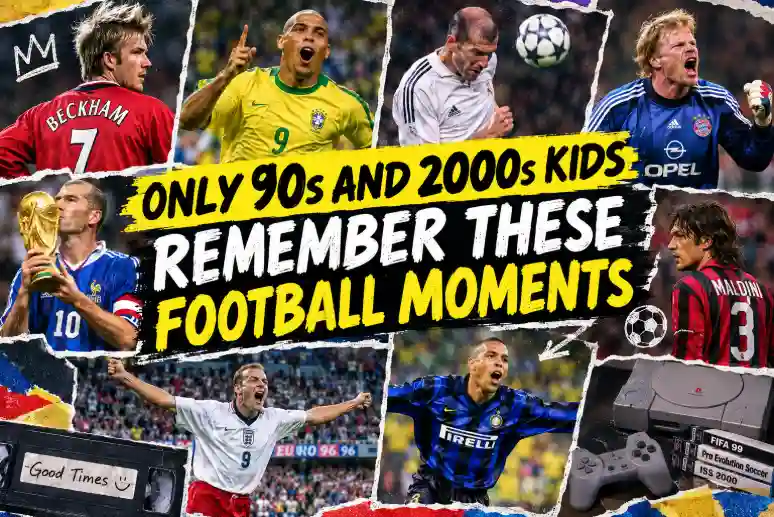
Only 90s and 2000s Kids Remember These Football Moments
- The pre-smartphone era turned tracking football into a tactile, shared adventure powered by Ceefax, playground banter, and magazines.
- Commercials like Nike’s "Secret Tournament" and Joga Bonito carried greater cultural weight than entire modern marketing seasons.
- Equipment, from baggy double-XL shirts to Adidas Predator Manias with red tongue bands, carried unmistakable character.
- While modern stars stay polished, this era featured raw unpredictability and cult legends, including the unforgettable names seen in our feature on wonderkids who never made it and where they are now.
You can still smell the damp winter grass if you close your eyes. You are standing in the schoolyard with freezing hands pulled inside sleeves that are three sizes too big. Someone has brought a scuffed, peeling leather ball that feels like a soaked bowling ball, and you are arguing passionately about a transfer rumor you read on a blocky television screen twelve hours earlier.
There was no instant push notification confirming a medical. There were no 4K slow-motion angle replays from forty different camera rigs. And there certainly were no twenty-second TikTok tactical analysis breakdowns.
Football in the 1990s and early 2000s lived in the imagination just as much as it lived on screen. It was raw, unscripted, deeply weird, and completely glorious. If you came of age during that magical window, you experienced a version of the beautiful game that simply does not exist anymore. Here is the unfiltered evidence of why that era remains permanently etched into our collective memory.
The Agony and Mystery of Ceefax Page 302
Today, if a player sneezes during a warm-up, seven different aggregator accounts post about it before he has reached for a tissue. But back then, finding out what happened to your team required nerves of steel and superhuman patience.
You pressed the TV remote to open Teletext or Ceefax, typed 302 with shaky fingers, and stared at the dark screen. Then came the wait. The little page counter in the top-left corner would cycle aimlessly through 1/4, 2/4, 3/4, while you prayed that your team had not conceded in the 89th minute.
When the screen finally blinked and refreshed, you scanned furiously for your club's name. A bright green font indicated a fresh scoreline change. A yellow line meant a red card. If your team had played an away game on a cold Tuesday night, this colorful wall of pixelated text was your entire universe.
And transfer gossip? It was pure madness. Rumors appeared on page 338 in two-line cryptic summaries. Real Madrid was allegedly preparing a world-record bid for a midfielder from Coventry City, and you had zero ways to verify it until the morning paper arrived at the local corner shop.
Nike’s Secret Tournament and the Golden Age of TV Adverts
Commercial breaks today are things people skip without a second thought. But in 2002, when the ad breaks came on, kids across the planet stopped what they were doing and refused to leave the room.
Enter the legendary Nike "Secret Tournament." Directed by Terry Gilliam, set deep inside the hull of a rusty cargo ship, and hosted by an impossibly suave Eric Cantona walking along iron gangways with a cane, it was an absolute fever dream of street swagger.
Eight three-player teams went head-to-head in a steel cage. First goal wins. You had Thierry Henry, Francesco Totti, and Hidetoshi Nakata in "The Trio." You had Roberto Carlos, Ronaldo, and Luís Figo in "The Os Tornados." The soundtrack was Junkie XL’s pulsating remix of Elvis Presley’s A Little Less Conversation, and within forty-eight hours, every kid in town was trying to replicate Henry’s scoop volley off the chain-link fence.
A few years later, Nike gave us the Joga Bonito series. Remember those Brazilian locker room clips filmed on gritty handheld camcorders? Ronaldinho smiling as he laced up golden Tiempo boots, juggling the ball four times off the crossbar without letting it touch the turf? Modern fans still debate whether that footage was real or CGI. Back then, we did not care—we went outside immediately to hit the crossbar, failed on the first kick, and chased the ball into our neighbor’s garden.
When Kits Were Enormous and Boots Were Lethal Weapons
Have you looked at a football match from 1998 recently? The kits looked like silk bedsheets flapping in an autumn hurricane. Players wore jerseys cut for heavyweights, with collars that flapped violently in the wind and shorts that stopped somewhere near their shins.
Yet somehow, they were the coolest garments ever stitched. Those silky, baggy shirts had iconic retro sponsors printed proudly across the chest. Sharp, Pirelli, Parmalat, Nintendo, O2, Carlsberg. They looked like authentic club identity rather than generic corporate placeholders.
Then there were the boots. In an era before neon pink slip-ons and carbon-fiber socks, real boots had weight, real leather, and unmistakable attitudes. If you had a pair of Adidas Predator Manias for the 2002 World Cup, you ruled the playground.
They featured rubber fins strategically placed across the strike zone, supposedly giving you thirty percent more swerve. But the defining feature was that majestic red tongue. You pulled it down over the laces and secured it beneath the sole with that thick, elastic rubber strap. If the elastic snapped after three wet games, you repaired it with electrical tape and kept playing without a hint of shame.
Crazy Haircuts and Pure Character on the Pitch
Modern players often look like they have walked out of the exact same grooming studio. Back in the late nineties and early aughts, footballers looked like characters from a comic book series.
Think about the sheer variety of legendary appearances that defined Sunday afternoons. You had Edgar Davids flying into crunching midfield tackles while rocking orange protective goggles and flowing dreadlocks. You had Taribo West marshalling the defense with neon-green antennas sprouting out of his scalp.
And who could possibly forget Ronaldo at the 2002 World Cup? Arriving in Japan and South Korea with a bizarre triangle patch of hair shaved into the front of his otherwise bald head. He later admitted he did it purely to divert journalists' attention away from his groin injury. It worked like a charm, he scored eight goals, took home the trophy, and convinced thousands of unlucky schoolboys to beg their furious parents for the exact same haircut.
The pitch drama had an edge you simply cannot recreate today. High-stakes clashes featured raw emotion, like the fiery tempers and intense fan friction explored in our look at transfer betrayals fans never forgave, where iconic names crossed bitter divides and faced unyielding stadium chaos.
Comparing Iconic Milestones of the 90s and 2000s
To really appreciate how rapidly the football landscape evolved across those two memorable decades, it helps to put the milestones, tech shifts, and cultural hallmarks right next to one another.
| Cultural Milestone | The 1990s Experience | The 2000s Evolution | Modern Context (2026) |
|---|---|---|---|
| Match Day Score Tracking | Waiting endlessly for Ceefax page 302 to cycle or listening to transistor radio static. | Early WAP mobile phone alerts, basic web forums, and dial-up goal tickers. | Millisecond live notifications, instantaneous video streams, and automated xG maps. |
| Kit Aesthetics & Design | Oversized, baggy synthetic shirts with loud zig-zags, seen in the ugliest kits ever worn in football. | Slightly tailored breathable mesh, iconic sponsors like O2 and Vodafone, high collars. | Ultra-tight compression jerseys designed strictly for wind tunnel aerodynamics. |
| Iconic Footwear Culture | Black leather Copa Mundials, early rubber Predator fins, and metal studs. | Predator Mania tongue straps, gold Mercurial Vapors, silver Total 90 boots. | Laceless lightweight synthetic shells weighing mere grams in vivid neon palettes. |
| Video Game Simulation | Sensible Soccer, FIFA 98: Road to World Cup with indoor wooden arenas. | Pro Evolution Soccer Master League, Adriano’s 99 shot power, PS2 glory years. | Card-collecting ultimate modes, live online matchmaking, dynamic esports metas. |
| Pre-Game Hype & Media | Weekly print magazines like Shoot! and Match with giant folded posters. | Soccer AM on Saturday morning, Showboat reels, and epic cinematic Nike ads. | Short-form vertical video clips, algorithm feeds, and personal player podcasts. |
| European Match Mystique | Rare foreign teams seen only in European cups; true tactical surprises. | Classic midweek Champions League nights on terrestrial free-to-air TV. | Universal scouting coverage where every foreign squad is thoroughly mapped out. |
Saturday Mornings, Soccer AM, and Peel-and-Stick Albums
Weekends in the 2000s had a sacred routine that started hours before the 3:00 PM kick-off whistle blew. You were awake early, pouring a massive bowl of sugary cereal, and switching on Soccer AM.
It was utterly chaotic television. You had fans of fourth-tier clubs packed into a cage, the legendary "Skill Skool" rap battles, the Crossbar Challenge where non-league fullbacks tried to strike timber, and Tim Lovejoy laughing his way through morning banter. It did not take itself seriously, and that was the whole point. Football was allowed to be goofy and lighthearted.
Then you broke out the Panini or Merlin sticker album. Tearing open that shiny foil packet gave you a rush no mobile app can ever recreate. Your thumb flicked through the stack: four players from Middlesbrough, an Ipswich Town midfielder you had never heard of, and then—glory of glories—a shiny foil club badge.
You carefully aligned the corners with the designated box on the page. If you crooked it, your heart sank, but you pressed it down anyway. Swapping duplicates at the school fence was serious business. Three bench players for one Thierry Henry shiny? That was the art of the deal.
The PlayStation 2 Master League Obsession
You cannot talk about football in the 2000s without talking about Pro Evolution Soccer. While FIFA had all the official badges and names, PES had the magic.
We did not care that Manchester United was called "Man Red" or that Chelsea was "London FC." We cared that the ball physics felt alive. Starting a Master League with Castolo leading the line alongside Minanda and Espimas was a rite of passage. You fought tooth and nail in division two, grinding out 1-0 wins in the pouring rain against West London White.
And let us never forget the cheat code that was Adriano in PES 6. Ninety-nine shot power. If you got within thirty-five yards of the net on his left foot, you did not aim—you just held the square button down and watched the digital net rip off its pegs. It was ridiculous, unbalanced, and completely unforgettable.
Why That Magic Can Never Be Replicated
It is easy to brush off this nostalgia as rose-tinted glasses. But something fundamental really did change over the last two decades. The mystery evaporated.
In the nineties and early 2000s, foreign superstars felt almost mythical. When you saw Zinedine Zidane, Gabriel Batistuta, or Gheorghe Hagi on a Tuesday night Champions League broadcast, you were watching figures that felt larger than reality. You could not see what they ate for lunch on Instagram. You could not watch clips of their training drills on Twitter.
When they did something breathtaking on the pitch, it felt like an authentic discovery. It belonged to the fans who happened to be watching at that exact second. That sense of collective wonder is what 90s and 2000s kids are really chasing when they reminisce about this era.
Frequently Asked Questions
Why do football fans feel so intensely nostalgic about the 1990s and 2000s era?
The era hit the sweet spot between elite athleticism and unpolished character. Before ubiquitous social media and high-definition hyper-analysis, players felt larger than life, broadcasts carried genuine mystique, and discovering transfer rumors required real patience.
What was the biggest difference in how fans tracked live scores back then?
Fans relied on television Teletext or Ceefax services like page 302, local radio commentary, and the rolling vidiprinter on Grandstand. You stared at an unchanging block of digital text for minutes, praying the scoreline would suddenly flash green to signal a goal.
Which commercial campaign defined 2000s football culture the most?
The Nike Secret Tournament inside an oil tanker cage for the 2002 World Cup, hosted by Eric Cantona to the beat of A Little Less Conversation, completely reshaped youth street football and defined football cool for a generation.
How did video games shape our appreciation of legendary teams during that decade?
PlayStation demo discs and classics like Pro Evolution Soccer 4, 5, and 6 gave supporters an intimate tactical feel for historic sides, letting gamers control dominant sides like the legendary squads examined in our breakdown of Arsenal’s Invincibles vs Liverpool 2019 vs Man City 2023: The Greatest Premier League Team Ever.
