

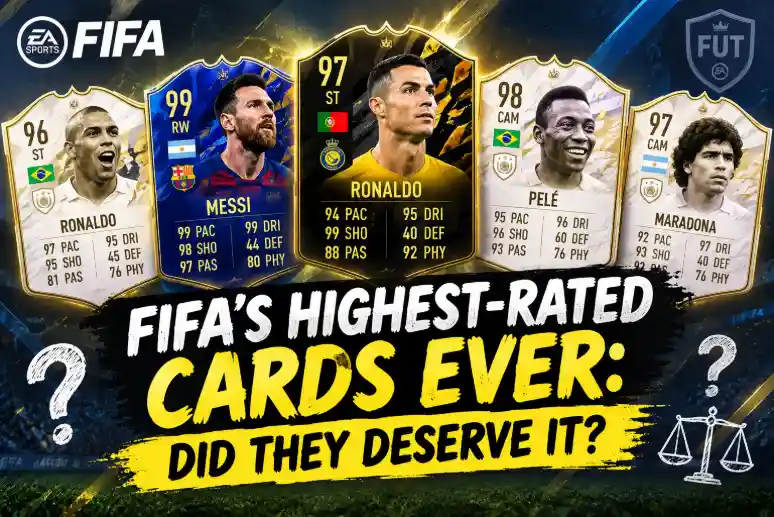
FIFA’s Highest-Rated Cards Ever: Did They Deserve It?
Key Takeaways: Peak Virtual Ratings vs. Reality
- The 99 Standard: Ultimate Team reserves 99 overalls almost exclusively for Team of the Year (TOTY), Team of the Season (TOTS), and end-game festival cards.
- The Pre-FUT Glitches: Early 2000s base ratings were wild, highlighted by Matteo Brighi's 97 in FIFA 2003 and Ronaldo Nazário's 98 in FIFA 2004.
- Defensive Milestone: Virgil van Dijk broke the defensive ceiling in FIFA 20, becoming the first center-back to hit the magical 99 threshold.
- Messi’s Record-Breakers: Leo's calendar-year goal explosions justified card ratings that bordered on science fiction, raising questions like what if Messi never left Barcelona and kept accumulating records.
- The Verdict: While modern 99-rated cards celebrate genuine historical campaigns, early EA formulas often confused raw athletic balance with generational greatness.
Every autumn, millions of controllers click furiously as gamers log on to scan player ratings. The arguments start immediately. Your club's top scorer is somehow stuck at an 83 pace, while an aging rival midfielder magically keeps an 88 overall. It is the annual ritual of EA Sports football, and nobody ever walks away completely satisfied.
Over the past three decades, EA has produced millions of digital cards. Most sit in the humble 70-to-85 bracket, forgotten by November. Yet a select few have climbed all the way to the summit. We are talking about the immortal 98s and the holy grail 99s. These cards transformed regular matches into arcade massacres and made weekend league controllers fly across living rooms.
Did these players actually earn those superhuman ratings on real grass? Or were they the product of marketing hype, broken calculation algorithms, and late-game power creep? Let us take a deep, honest walk through football gaming history to separate the true masterclasses from the statistical illusions.
The Wild West of Early Disc Releases: 98s, 97s, and Matteo Brighi
Before Ultimate Team arrived in FIFA 09 to monetize card packs, ratings were baked straight into the retail disc. You popped the CD into your PlayStation 2 or PC, loaded exhibition mode, and accepted whatever the developers in Vancouver had punched into their spreadsheets.
During that era, EA had no live tuning updates. There were no weekly promos, no dynamic performance trackers, and certainly no weekend patches. If an algorithm gave a player a silly rating in August, you were stuck playing with that demigod until the next year's game hit store shelves.
That freedom produced some of the most hilarious anomalies in gaming history. Today, fans remember those early editions with pure nostalgia, a golden period covered in our look back at the classic football moments from the 90s and 2000s that shaped gaming culture.
The undisputed king of rating blunders belongs to FIFA 2003. When players booted up the game, the highest-rated footballer on the planet was not Zinedine Zidane, Thierry Henry, or Ronaldo Nazário. It was Matteo Brighi, a young Italian midfielder on loan at Bologna, standing tall at an absurd 97 overall.
So, did Brighi deserve to be rated higher than peak Zidane? Absolutely not. Brighi was a solid, energetic prospect who won Serie A Young Footballer of the Year in 2002. But EA's rating system back then did not weight prestige or positional mastery. Instead, it ran an aggregate equation where every individual stat contributed equally to the overall score.
Because Brighi had decent stamina, respectable tackling, acceptable vision, and fair pace, the engine determined he was basically the most complete human ever to lace up boots. Juventus never even made him a regular starter. He went on to enjoy a respectable journeyman career across Italy, but he was never the finest player on earth.
A year later, FIFA 2004 delivered another monster: Ronaldo Nazário with a 98 overall base card. Unlike Brighi, R9 actually had the talent to justify such a score. Playing for Real Madrid, O Fenômeno was coming off his 2002 World Cup redemption and tearing La Liga apart with speed that defied physics. While a 98 base card broke game balance, few purists argued that the Brazilian forward was anything less than unstoppable.
The 99 Club: The Golden Standard of Ultimate Team
When Ultimate Team debuted as an add-on game mode, EA established an unspoken rule: 99 was the unreachable ceiling. It was meant to signify perfection, an honor reserved solely for historical achievements or end-of-year celebratory squads.
Over the years, the barrier slowly eroded. As promo calendars expanded to keep players buying packs into mid-summer, 99 cards evolved from once-in-a-decade rarities into annual fixtures. Still, analyzing the earliest 99s shows a fascinating battle between genuine sporting dominance and commercial momentum.
The table below outlines the most famous ultra-rated cards in franchise history, highlighting their real-world achievements and whether their digital divinity was truly justified.
| Player & Game | Card Type | Real-World Season | Key Feats | Verdict: Deserved? |
|---|---|---|---|---|
| Matteo Brighi (FIFA 2003) | Base Gold (97) | 2001-02 Bologna | Serie A Young Player of the Year | No. Algorithmic error; good midfielder, never world elite. |
| Ronaldo Nazário (FIFA 2004) | Base Gold (98) | 2002-03 Real Madrid | 30 goals, La Liga title, Ballon d'Or | Yes. Pure unadulterated peak greatness. |
| Lionel Messi (FIFA 12) | Record Breaker (99) | 2011-12 Barcelona | 73 club goals, 91 calendar year goals | Undisputed Yes. Greatest individual scoring season in modern football history. |
| Cristiano Ronaldo (FIFA 18) | TOTY (99) | 2016-17 Real Madrid | Champions League double, clutch knockout goals | Yes. Carried Madrid in European knockouts, proving decisive in our classic comparison of Barcelona 2011 against Real Madrid 2017. |
| Luka Modrić (FIFA 19) | TOTY (99) | 2017-18 Real Madrid / Croatia | UCL trophy, World Cup final, Ballon d'Or | Debatable. Incredible year, but individual raw dominance was softer than Messi or Ronaldo. |
| Virgil van Dijk (FIFA 20) | TOTY (99) | 2018-19 Liverpool | UCL winner, zero dribbles conceded across 65 games | Yes. Best individual defending season seen in the modern Premier League era. |
| Robert Lewandowski (FIFA 20) | TOTY / TOTS (99) | 2019-20 Bayern Munich | Sextuple winner, 55 goals across 47 appearances | Undisputed Yes. Robbed of the real-world Ballon d'Or; fully deserved maximum virtual respect. |
The Inevitable Duopoly: Messi and Cristiano at 99
For roughly a decade, world football was defined by two men. EA reflected that rivalry perfectly. Whenever Messi dropped a 99 card, Cristiano Ronaldo would inevitably get one a few months later, keeping both fanbases quiet.
Take Lionel Messi’s FIFA 12 Record Breaker card. That blue-and-red item hit the market after he shattered Gerd Müller's all-time calendar goal record, finishing 2012 with an unimaginable 91 goals. In competitive club matches, he scored 73 times for Barcelona in a single campaign.
There was zero debate. If 91 goals in a calendar year does not warrant a 99 rating, then EA might as well delete the number from their system. It remains the gold standard of deserved card ratings. In-game, his agility and left-foot finesse shots made opposing defenders look like traffic cones.
Cristiano Ronaldo had his own undisputed masterpiece with his FIFA 18 Team of the Year 99 card. Leading Real Madrid to back-to-back Champions League titles, CR7 demolished Bayern Munich, Atlético Madrid, and Juventus in the knockout stages. He scored five against Bayern over two legs and netted a hat-trick against Atlético.
Did he deserve the 99? Without question. His physical dominance, clutch heading, and predatory instincts inside the box were at their absolute historic apex. Gamers who packed him essentially gained an automatic victory button.
The Outliers: When Midfielders and Defenders Joined the Gods
For years, community members complained that 99 ratings were strictly locked behind attacking goal tallies. Wingers and strikers hoarded the top spots while world-class defenders lingered in the lower 90s. Then came FIFA 19 and FIFA 20, completely rewriting EA’s promo philosophy.
Luka Modrić (FIFA 19 TOTY - 99 Overall)
When Luka Modrić snapped the Messi-Ronaldo duopoly by winning the 2018 Ballon d'Or, EA had a massive dilemma. In previous years, even prime midfielders like Xavi, Iniesta, and Andrea Pirlo capped out at 97 or 98. Granting Modrić a 99 felt radical.
Was it deserved? This remains one of the community's hottest barroom arguments.
- The Case For: He pulled the strings for Real Madrid’s third straight Champions League crown and dragged an underdog Croatian squad to the World Cup final.
- The Case Against: Modrić scored just two club goals in that 2017-18 season and registered fewer than ten assists. His greatness was subtle, dictating tempo rather than shattering scoreboards.
- The Verdict: A magnificent footballer having a career-defining year, but giving him identical numerical weight to 73-goal Messi was more about honoring the Ballon d'Or trophy than representing pure pitch supremacy.
Virgil van Dijk (FIFA 20 TOTY - 99 Overall)
Defenders rarely get historical credit, but Virgil van Dijk’s 2018-19 season with Liverpool forced EA’s hand. During that historic campaign, the Dutch colossus went 65 consecutive competitive matches without a single opponent successfully dribbling past him.
He won the UEFA Men's Player of the Year, finished runner-up to Messi for the Ballon d'Or by seven tiny votes, and guided Liverpool to Champions League glory. When EA awarded him a 99 TOTY item in FIFA 20, the gaming world paused. He had 90 pace, 99 defending, and 99 physical stats. Striking through him was virtually impossible.
Did he deserve it? Yes. Defensive excellence is notoriously tough to quantify, but Van Dijk reached an aura of invincibility that transformed an entire club. If Paolo Maldini or Franco Baresi played in the modern Ultimate Team era, they would have celebrated the same digital crowning.
Robert Lewandowski (FIFA 20 TOTY & TOTS - 99 Overall)
In 2020, Bayern Munich won every single trophy available: the Bundesliga, the DFB-Pokal, and the Champions League. Spearheading that Bavarian machine was Robert Lewandowski, who posted 55 goals in 47 matches and finished as top scorer in all three competitions.
Then, France Football canceled the 2020 Ballon d'Or ceremony due to global disruptions, robbing the Polish striker of his golden moment. EA did what the real world failed to do. They gave Lewandowski a 99-rated TOTY and a 99-rated TOTS card. It was poetic justice, and not a single football analyst on earth could claim he had not earned every single attribute point.
The Summer Promo Trap: When Everyone Becomes a 99
While winter TOTY cards carry historical reverence, recent editions of FIFA and EA Sports FC introduced an uncomfortable reality: Summer Promo Inflation. By July and August, cards stop reflecting actual football and become pure fan fiction.
Between Shapeshifters, Futties, and Cover Star Icons, cards with 99 overalls have been handed to players for bizarre reasons:
- Out-of-position goalkeepers playing at center-forward with 99 shooting.
- Defensive midfielders like N'Golo Kanté gaining 99 dribbling and 99 finishing.
- Promising youngsters receiving higher ratings than legendary World Cup winners.
These end-game cards are designed to keep pack engagement high during the dog days of summer before the next retail title ships. They do not represent real pitch accolades, and treating them as reflections of true footballing ability is a mistake. When every team has five 99-rated players running at full sprint, the rating ceases to mean anything.
Evaluating the True Legacy of FIFA Ratings
When we look back at the pantheon of maximum-rated cards, context tells the whole story. A 99 rating awarded in January during Team of the Year carries tremendous weight, reflecting an unforgettable twelve months of sweat, tactical brilliance, and silverware.
Early mistakes like Matteo Brighi in FIFA 2003 remind us that computers cannot simply sum up stats to determine genius. Football is an art form. It is about timing, composure under pressure, and spatial awareness—traits that cannot easily be condensed into an overall number between 1 and 99.
Yet when EA gets it right—honoring prime Messi, apex Ronaldo, impenetrable Van Dijk, or clinical Lewandowski—those cards become digital monuments. They capture a snapshot of athletic perfection that reminds us why we fell in love with both the real sport and the virtual pitch in the first place.
Frequently Asked Questions
Has any base gold card ever reached a 99 rating in FIFA history?
No base gold card in FIFA or EA Sports FC Ultimate Team history has ever launched at 99 overall. The highest base ratings in the Ultimate Team era topped out at 94, held jointly by Lionel Messi and Cristiano Ronaldo during their respective prime La Liga campaigns. Base cards rated above 94 only occurred in vintage offline console editions from the early 2000s before Ultimate Team was invented.
Why did Matteo Brighi receive a 97 rating in FIFA 2003?
Brighi had just claimed the Serie A Young Footballer of the Year award while on loan at Bologna from Juventus. Because the old EA algorithmic formula heavily over-indexed on balanced physical, mental, and technical metrics without strict manual capping, his complete box-to-box profile mechanically triggered an astronomical 97 overall calculation.
Who was the first defender to receive a 99-rated card in Ultimate Team?
Virgil van Dijk became the first defender to earn an undisputed 99 rating in Ultimate Team during FIFA 20's Team of the Year promo. His immaculate 2018-19 Champions League campaign with Liverpool and runner-up finish in the Ballon d'Or convinced EA to grant a defender flawless card status.
How do EA Sports ratings correlate to building an elite squad?
Ratings often reflect commercial hype and end-of-season awards rather than pure tactical balance. If you are constructing an unstoppable fantasy lineup with the world's most valuable players, check out our guide on how to build your €1 billion dream XI to see how real-world value matches virtual performance.
Explore Further on FootballPress
Looking for more fascinating deep dives into player potential, career arcs, and legendary team debates? Browse our related analyses:
- Discover what happened to the game's brightest prospects in our report on wonderkids who never made it and where they are today.
