
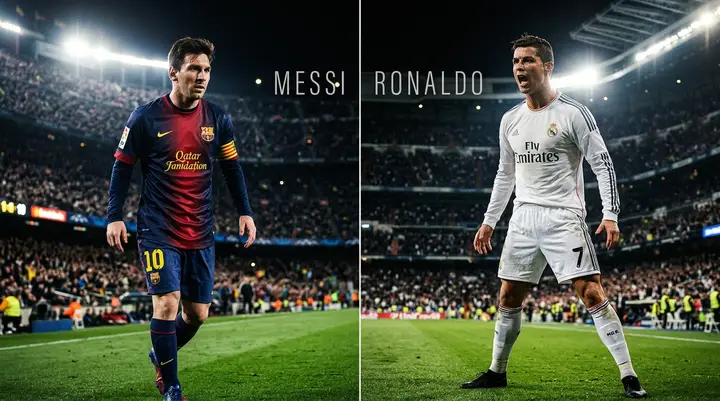
- Ronaldo dominated raw knockout resilience and volume scoring across England, Spain, and Italy.
- Messi produced higher peak efficiency, setting single-season output ceilings that still look surreal.
- While their goal counts remain neck and neck, Messi's playmaking volume and international crowning moment separate them.
- Check out our tactical study on Haaland vs. Mbappé: Two Ways to Score to see how the next generation compares.
Every generation gets one rivalry that defines its playground arguments and Sunday bar talks. For over fifteen years, football fans were treated to two alien talents pushing each other to heights nobody thought humanly possible.
You either loved the relentless, sculpted athletic drive of Cristiano Ronaldo or the effortless, low-center-of-gravity genius of Lionel Messi. There was rarely any middle ground. Fans chose a side, built emotional fortresses around their hero, and refused to budge.
Now, in late 2026, with Messi retired from international football after the 2026 World Cup final and both still playing club football, we can step back from the weekly social media noise. When you lay the raw numbers, the titles, and the moments side by side, what does the complete picture actually show?
The Defining Eras: How Their Journeys Mirrored Each Other
Ronaldo arrived on the global radar first, dazzling Old Trafford with stepovers before converting himself into a ruthless scoring machine under Sir Alex Ferguson. By 2008, he had collected his first Ballon d'Or and Champions League title.
Then Pep Guardiola unleashed Messi centrally at Barcelona. What followed between 2009 and 2018 in Spain was arguably the greatest sustained individual duel in the history of global sport. El Clásico ceased to be just a fixture; it became a global referendum on sporting philosophy.
Ronaldo attacked the box with terrifying aerial power, rapid transitional speed, and clutch finishes. Messi dismantled defensive blocks with passing vision, close control, and laser-guided finishes from outside the box.
And their seasonal outputs reflected that relentless feedback loop. In 2011–12 Ronaldo scored 46 La Liga goals; Messi scored 50. In 2014–15 Ronaldo’s 48 beat Messi’s 43.
Season-by-Season Table
Here are both players’ club goals season by season, followed by their career totals. All figures are official first-team matches.
| Lionel Messi | Cristiano Ronaldo | |
|---|---|---|
| First-team club goals | 811 in 976 games | 839 in 1,109 games |
| International goals | 126 in 208 (Argentina) | 146 in 234 (Portugal) |
| Total official goals | 937 | 985 |
| Best club season | 73 goals (2011–12) | 61 goals (2014–15) |
| Ballon d’Or | 8 | 5 |
| Champions League titles | 4 | 5 |
| Major international titles | World Cup 2022, Copa América 2021 and 2024 | Euro 2016, Nations League 2019 and 2025 |
Source: career statistics and honours on the players’ Wikipedia pages, checked 6 November 2026. Totals calculated by FootballPress from first-team club and senior international matches.
| Season | Club | League goals (games) | All competitions goals (games) |
|---|---|---|---|
| 2004–05 | Barcelona | 1 in 7 | 1 in 9 |
| 2005–06 | Barcelona | 6 in 17 | 8 in 25 |
| 2006–07 | Barcelona | 14 in 26 | 17 in 36 |
| 2007–08 | Barcelona | 10 in 28 | 16 in 40 |
| 2008–09 | Barcelona | 23 in 31 | 38 in 51 |
| 2009–10 | Barcelona | 34 in 35 | 47 in 53 |
| 2010–11 | Barcelona | 31 in 33 | 53 in 55 |
| 2011–12 | Barcelona | 50 in 37 | 73 in 60 |
| 2012–13 | Barcelona | 46 in 32 | 60 in 50 |
| 2013–14 | Barcelona | 28 in 31 | 41 in 46 |
| 2014–15 | Barcelona | 43 in 38 | 58 in 57 |
| 2015–16 | Barcelona | 26 in 33 | 41 in 49 |
| 2016–17 | Barcelona | 37 in 34 | 54 in 52 |
| 2017–18 | Barcelona | 34 in 36 | 45 in 54 |
| 2018–19 | Barcelona | 36 in 34 | 51 in 50 |
| 2019–20 | Barcelona | 25 in 33 | 31 in 44 |
| 2020–21 | Barcelona | 30 in 35 | 38 in 47 |
| 2021–22 | Paris Saint-Germain | 6 in 26 | 11 in 34 |
| 2022–23 | Paris Saint-Germain | 16 in 32 | 21 in 41 |
| 2023 | Inter Miami | 1 in 6 | 11 in 14 |
| 2024 | Inter Miami | 20 in 19 | 23 in 25 |
| 2025 | Inter Miami | 29 in 28 | 43 in 49 |
| 2026 | Inter Miami | 26 in 30 | 30 in 35 |
Source: club career statistics on Wikipedia (compiled from BDFutbol, Soccerway and official competition data), Messi updated to 1 November 2026, Ronaldo to 29 October 2026; checked 6 November 2026. First-team club matches only. Inter Miami seasons are calendar years; the 2026 and 2026–27 rows are incomplete.
| Season | Club | League goals (games) | All competitions goals (games) |
|---|---|---|---|
| 2002–03 | Sporting CP | 3 in 25 | 5 in 31 |
| 2003–04 | Manchester United | 4 in 29 | 6 in 40 |
| 2004–05 | Manchester United | 5 in 33 | 9 in 50 |
| 2005–06 | Manchester United | 9 in 33 | 12 in 47 |
| 2006–07 | Manchester United | 17 in 34 | 23 in 53 |
| 2007–08 | Manchester United | 31 in 34 | 42 in 49 |
| 2008–09 | Manchester United | 18 in 33 | 26 in 53 |
| 2009–10 | Real Madrid | 26 in 29 | 33 in 35 |
| 2010–11 | Real Madrid | 40 in 34 | 53 in 54 |
| 2011–12 | Real Madrid | 46 in 38 | 60 in 55 |
| 2012–13 | Real Madrid | 34 in 34 | 55 in 55 |
| 2013–14 | Real Madrid | 31 in 30 | 51 in 47 |
| 2014–15 | Real Madrid | 48 in 35 | 61 in 54 |
| 2015–16 | Real Madrid | 35 in 36 | 51 in 48 |
| 2016–17 | Real Madrid | 25 in 29 | 42 in 46 |
| 2017–18 | Real Madrid | 26 in 27 | 44 in 44 |
| 2018–19 | Juventus | 21 in 31 | 28 in 43 |
| 2019–20 | Juventus | 31 in 33 | 37 in 46 |
| 2020–21 | Juventus | 29 in 33 | 36 in 44 |
| 2021–22 | Juventus | 0 in 1 | 0 in 1 |
| 2021–22 | Manchester United | 18 in 30 | 24 in 38 |
| 2022–23 | Manchester United | 1 in 10 | 3 in 16 |
| 2022–23 | Al-Nassr | 14 in 16 | 14 in 19 |
| 2023–24 | Al-Nassr | 35 in 31 | 50 in 51 |
| 2024–25 | Al-Nassr | 25 in 30 | 35 in 41 |
| 2025–26 | Al-Nassr | 28 in 30 | 30 in 37 |
| 2026–27 | Al-Nassr | 8 in 10 | 9 in 12 |
Source: club career statistics on Wikipedia (compiled from BDFutbol, Soccerway and official competition data), Messi updated to 1 November 2026, Ronaldo to 29 October 2026; checked 6 November 2026. First-team club matches only. Inter Miami seasons are calendar years; the 2026 and 2026–27 rows are incomplete.
The tables show a clear pattern. Ronaldo started faster: by 2007–08 he was scoring 42 goals a season at Manchester United, while Messi was still breaking through. Messi’s four-season peak, from 2009–10 to 2012–13 (233 club goals), is the best run either player managed; Ronaldo’s best four seasons in a row produced 227. Ronaldo’s scoring then lasted longer, with 50 goals for Al-Nassr in 2023–24, the season he turned 39. To understand how that translates on the big stage, read our tactical breakdown on how a Champions League final is won.
Scoring Volume vs. Complete Influence
Ronaldo fans will point directly to his ridiculous longevity and his unmatched record in the Champions League knockout stages. And they are completely justified. Nobody stepped onto a pitch with ice water in their veins quite like Cristiano against elite European opposition.
He scored in three different Champions League finals. He turned elimination ties on their head against Wolfsburg, Bayern Munich, and Atlético Madrid almost single-handedly. He conquered England, conquered Spain, and conquered Italy.
So where does the scale tilt? It tilts the moment you zoom out from raw goal tallies and look at how matches were controlled.
Messi was not just Barcelona's primary goal scorer; he was their chief orchestrator. He led Europe repeatedly in progressive passes, completed dribbles, through balls, and big chances created. When you evaluate total goal contributions alongside playmaking metrics, Leo regularly operated as an elite number 9 and an elite number 10 wrapped inside one shirt.
- Playmaking Gap: Messi has far more career assists than Ronaldo, reflecting his role as a creator as well as a finisher.
- Disciplinary Record: Ronaldo picked up significantly more red cards, reflecting his combative temperament.
- Individual Accolades: Messi pulled clear with eight Ballon d'Or trophies compared to Ronaldo's five.
- Silverware: Messi holds the record for most senior trophies won by an individual footballer.
The 2026 Verdict
For over a decade, we resisted naming a winner because their battle was so symphonically balanced. Ronaldo gave us the ultimate blueprint of what supreme ambition, work ethic, and athletic conditioning could achieve. He remains the greatest goal-scoring specialist the sport has ever seen.
But the verdict from our modern 2026 vantage point must go to Lionel Messi.
The difference is not merely the glittering World Cup trophy he raised in Qatar, although that completed the definitive fairytale narrative. The difference lies in the breadth of Messi's game.
Ronaldo could win you a match with an impossible header or a venomous strike when his team was under the cosh. Messi could do that, but he could also pull all strings from forty yards out, dictate the match tempo, carve a defense open with a single flick, and walk off the pitch with two goals and two assists.
Both rewrote history. Both gave us memories we will tell our grandchildren about. But Messi remains the most complete footballer who ever kicked a ball.
Frequently Asked Questions
Who scored more total official career goals between Messi and Ronaldo?
Cristiano Ronaldo, with 985 official goals to Messi’s 937 by our count of first-team club and senior international matches (late October 2026). Ronaldo has played about 160 more games; Messi has the slightly higher goals-per-game rate and far more assists.
Who holds the record for most goals scored in a single club season?
Lionel Messi holds the all-time European record with 73 goals in all competitions for FC Barcelona during the 2011-12 campaign, netting 50 in La Liga alone. Ronaldo's peak single-season output was 61 goals for Real Madrid in 2014-15.
Did the 2022 World Cup permanently settle the rivalry?
For the majority of neutrals and analysts, Messi captaining Argentina to the World Cup trophy provided the ultimate trump card. However, Ronaldo supporters emphasize his unmatched five UEFA Champions League crowns and sustained dominance across three distinct major European leagues.