
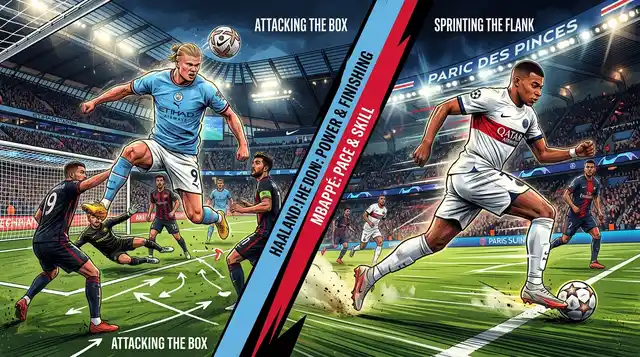
- Haaland converts chances through elite blind-side box positioning and first-touch finishing.
- Mbappé generates his own opportunities off dynamic carries, rapid deceleration, and wide-channel isolations.
- City shapes their possession around Haaland's gravity, driving him toward historic Premier League goals-per-game records.
- Madrid leverages Mbappé's duel-winning ability to destroy structured defensive shapes on the break.
Football arguments never really stop; they just trade names. We spent fifteen years picking between two generational icons, and now the global debate revolves around Erling Haaland and Kylian Mbappé. But watching these two tear up European scoreboards highlights something fascinating: they share almost nothing in common on a pitch.
They both put up outrageous scoring numbers that ruin conventional metrics. Yet the way each man manufactures a goal feels like it belongs to an entirely different sport. One plays like a penalty-box heat-seeking missile. The other behaves like a lightning-fast perimeter playmaker who slices inward to kill off defenders.
Let's unpack the mechanics behind both players and see how their distinct archetypes create goals.
The Box Monster: How Erling Haaland Breaks Defenses
Haaland treats the penalty box like his personal workshop. While modern football obsessively demands that strikers drop deep, link play, and drift into wide pockets, the Norwegian giant flips that thinking on its head. He stays central, pins center-backs into uncomfortable positions, and strikes when opponents blink.
His real genius is not merely raw muscle or sprint speed, though he has plenty of both. It comes down to microscopic spatial awareness. Watch him when Manchester City work the ball down the wing: Haaland rarely stands completely still. He drifts behind the shoulder of the far-side center-back where defenders lose track of him.
The moment a cutback or cross leaves his teammate's boot, Haaland bursts across the defender's front post. Defenders know the run is coming, but his timing and acceleration over three yards are virtually impossible to stop. He does not waste time touching the ball four times; most of his strikes are crisp, violent first-time finishes.
Studying his shot selection through what expected goals reveals shows that Haaland takes an overwhelming percentage of his shots inside the twelve-yard zone. He does not take hopeful speculative shots from thirty yards out. He waits, stalks the box, and cleans up high-value territory with merciless efficiency.
That extreme economy of touch is precisely what makes him unstoppable under Pep Guardiola's framework. Haaland can complete only nine passes across ninety minutes and still walk off the pitch with a hat-trick match ball.
The Perimeter Conjuror: Kylian Mbappé's Dynamic Threat
Mbappé approaches goalscoring from the complete opposite direction. Confining the French superstar inside the penalty box suffocates his greatest gifts. He needs oxygen, open grass, and an isolated defender to torment.
Operating primarily out of the left half-space, Mbappé treats the final third like a dynamic duel. He picks up the ball facing forward, often forty yards away from the goal line. That immediately sends panic through defensive structures because nobody wants to backpedal against his raw top-end speed.
What sets Mbappé apart is his violent shift of gears. He does not just run fast in a straight line; he slows down to lull defenders to sleep, drops his shoulder, and explodes past their front foot. By the time a center-back slides across to provide cover, Mbappé has already shaped his body to strike.
His signature finish is instantly recognizable across world football:
- Driving hard inside from the left flank toward the box.
- Freezing the goalkeeper with subtle hip orientation.
- Curling the ball into the far corner or snapping a quick near-post strike before anyone sets their feet.
Unlike Haaland, Mbappé generates massive scoring volume through self-creation. If his midfield goes quiet, he does not starve. He simply drops toward the middle third, demands the ball into his feet, drives through two challenges, and creates an angle out of thin air.
Head-to-Head: Tactical Profiles and Shot Profiles
Putting these profiles side by side exposes just how radically their tactical blueprints differ across every phase of an attacking sequence.
| Metric & Trait | Erling Haaland | Kylian Mbappé |
|---|---|---|
| Primary Operating Zone | Six-yard box and central penalty spot | Left half-space and wide channels |
| Finishing Mechanism | First-touch tap-ins, headers, direct volleys | Dribble-to-shoot carries, curlers, near-post whips |
| Shot Creation Style | Relies on pinpoint crosses, cutbacks, second balls | Isolates defenders 1v1, manufactures own space |
| Movement Tendency | Blind-side darting runs across the center-back | Deep drops, diagonal sprints behind backlines |
The numbers reflect these contrasting roles clearly. Haaland's average shot distance rarely exceeds ten yards. Mbappé routinely tests keepers from fifteen to twenty yards out because his shooting angle opens up as he cuts across defensive shields.
System Demands: What Each Striker Requires from a Team
Because their profiles are so specialized, building an elite team around either forward demands completely distinct tactical ecosystems.
Put Haaland in a squad that lacks reliable wing play or inventive passers, and he can look isolated. He thrives on sustained territorial dominance where his team pins the opponent back and feeds continuous balls into dangerous zones. He is the ultimate sledgehammer for a possession-heavy powerhouse.
Mbappé, on the other hand, requires functional balance behind him. Because he expends massive energy on high-speed ball-carrying and explosive attacking transitions, managers must pair him with disciplined full-backs and hard-working central midfielders who cover the wide channel when possession turns over.
So which approach is better? The answer depends entirely on what your team needs. If you already control seventy percent of the ball and struggle to break down low blocks, Haaland gives you guaranteed output inside the six-yard box. If you want a dynamic superstar capable of tearing apart an open match on the break, Mbappé remains virtually peerless.
Frequently Asked Questions
Who is more reliant on service between Haaland and Mbappé?
Haaland depends significantly more on pinpoint delivery from wide areas and central creators. Mbappé can pick up possession thirty yards out, isolate defenders one-on-one, and create clean shooting angles entirely by himself.
Can Haaland and Mbappé play together in the same front line?
Theoretically, they would complement each other brilliantly. Mbappé thrives attacking vacated half-spaces and drawing defensive attention off the left wing, which leaves Haaland with single coverage inside the central six-yard box.
Whose finishing technique holds up better in low-block matches?
Haaland generally excels against stubborn low blocks because his physical size, blind-side box movement, and first-time poaching punish defenders who pack their own penalty box with numbers.
Curious how this individual rivalry stacks up historically? Check out our breakdown of the classic Messi vs. Ronaldo debate to see how generational goalscorers reshaped attacking football.