
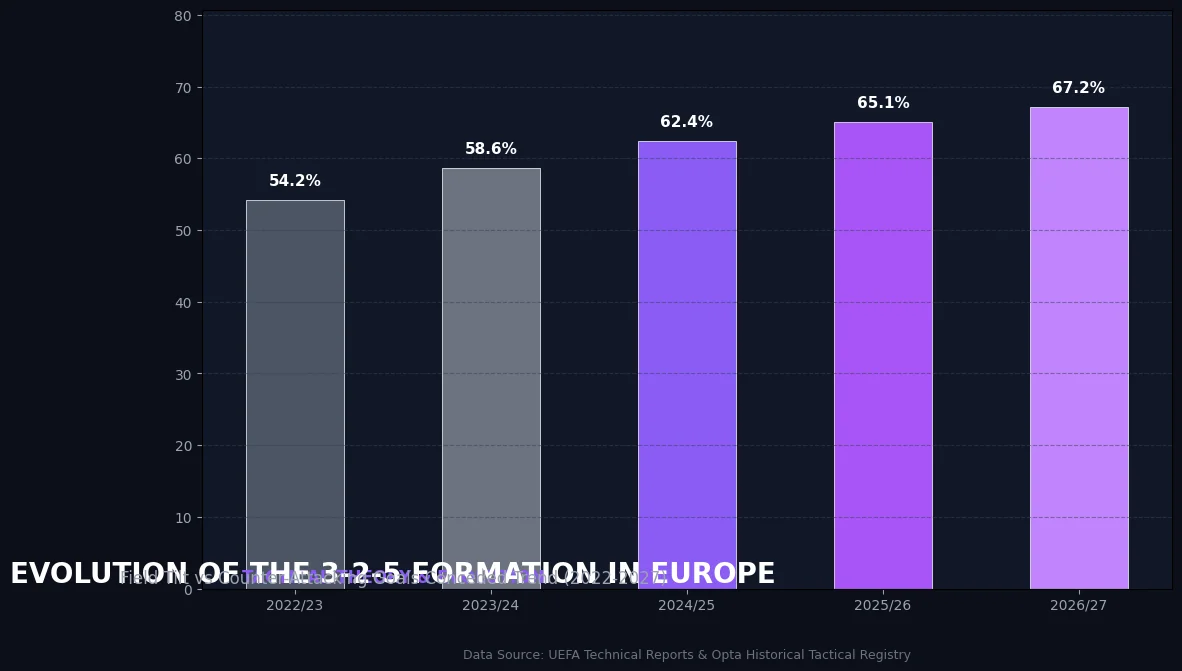
Quick verdict: The 3-2-5 became the dominant attacking shape of the 2020s because it fills all five vertical lanes of the pitch while keeping five players behind the ball. Its success produced a response: deeper, narrower defensive blocks, man-oriented pressing and fast counter-attacks aimed at the space around the two holding midfielders.
Line-ups printed before kick-off still say 4-3-3 or 4-2-3-1, but in possession most elite teams now attack in a very similar shape: three players at the back, two in central midfield and five spread across the front. Understanding why it spread, and how opponents fight it, explains a lot about modern football.
1. What a 3-2-5 Is
The shape is about positions with the ball, not the formation on the team sheet. Teams create it in different ways:
- An inverted full-back: one full-back moves into midfield, as Oleksandr Zinchenko did for Mikel Arteta's Arsenal in 2022/23.
- A centre-back stepping up: John Stones moving into midfield alongside Rodri was a key feature of Manchester City's 2022/23 treble season.
- A midfielder dropping: a holding midfielder drops between the centre-backs while the full-backs push high.
2. Why It Spread
- Five lanes occupied: two wide players pin the full-backs, two inside forwards attack the half-spaces and the striker occupies the centre-backs.
- Built-in rest defence: three defenders and two midfielders stay behind the ball, ready to stop counter-attacks before they start.
- Easier counter-pressing: with players spread evenly, the team can surround the ball quickly after losing it.
3. The Counter-Response
Defending teams adapted in three main ways:
- Narrow, deep blocks: a compact 5-4-1 or 4-5-1 protects the half-spaces and accepts that the opponent will have the ball.
- Man-oriented pressing: instead of guarding zones, defenders follow direct opponents, which disrupts the rotations a 3-2-5 depends on.
- Targeted counter-attacks: the space either side of the two holding midfielders, and behind the wide centre-backs, is where quick transitions do most damage.
4. What Comes Next
The newest trend is less fixed structure: players rotate more freely, teams change shape within a match, and man-oriented pressing is spreading. The 3-2-5 remains the reference point, but the best sides now vary it constantly so opponents cannot prepare for one picture.
Further reading
Frequently Asked Questions
What is a 3-2-5 formation?
A 3-2-5 is an in-possession shape with three players at the back, two central midfielders and five attackers spread across the width of the pitch. Teams often line up as a 4-3-3 or 4-2-3-1 and move into it when they have the ball.
Why do so many teams attack in a 3-2-5?
It occupies all five vertical lanes of the pitch while keeping five players behind the ball, which balances attacking width with protection against counter-attacks.
How do you beat a 3-2-5?
Common answers are a compact deep block that protects the half-spaces, man-oriented pressing that disrupts rotations, and quick counter-attacks into the space around the two holding midfielders.