
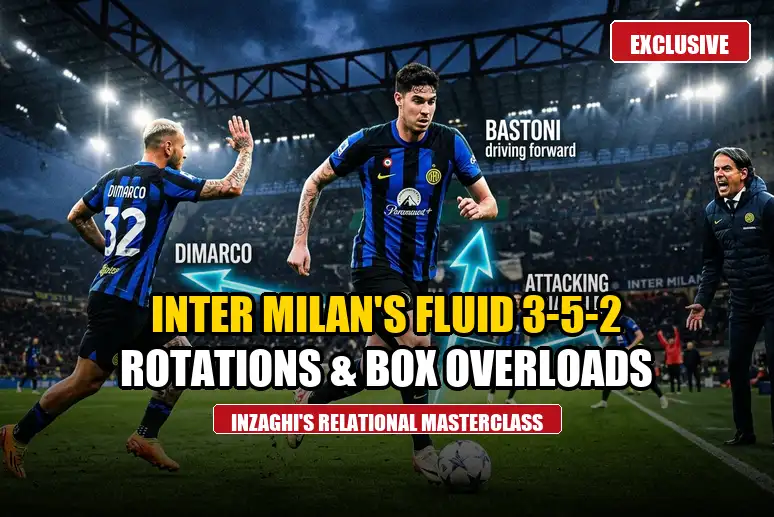
The modern 3-5-2 formation was long associated with pragmatic conservatism—a compact low block designed to absorb pressure, clog the central channels, and launch direct vertical counter-attacks through split wingers or target forwards. Under Simone Inzaghi (2021–2025), however, Inter Milan redefined the tactical paradigm of three-center-back systems. At their peak, the Nerazzurri operated not with rigid mechanical passing patterns, but as one of Europe’s premier exponents of relational positional play. Rather than adhering to fixed positional lanes, Inter’s players rotate dynamically across vertical zones, turning nominal center-backs into deep-lying playmakers, shifting wing-backs into the half-spaces, and flooding the opponent’s penalty box with devastating numerical overloads.
Understanding Inter Milan’s tactical dominance requires dissecting how their structure disorganizes opposition defensive lines, why their progressive metrics outpace traditional back-four systems, and how specific positional rotations allow them to control elite European fixtures.
1. Buildup Architecture: The Deep Pivot and Spreading Center-Backs
The foundation of Inter's attacking framework begins in the first phase of buildup. While traditional three-at-the-back systems rely on the central center-back to initiate possession, Inter’s structure is anchored by deep-lying regista Hakan Çalhanoğlu. Çalhanoğlu does not simply sit ahead of the defensive line; he frequently drops into the backline between the center-backs or slips into the left half-space, creating an adaptive back four or asymmetric three.
This fluid positioning creates an immediate conundrum for opposition pressing forwards:
- Pressing Dilemma: If an opponent presses in a two-man front line, Çalhanoğlu’s drop creates a 4v2 or 3v2 overload, giving Inter clean passing lanes into the wide channels.
- Vertical Expansion: By dropping deep, Çalhanoğlu lures the opposing midfield line forward, vacating acres of space between the opposition’s midfield and defensive lines.
- First-Touch Progression: Rather than recycling possession horizontally, Çalhanoğlu looks for immediate line-breaking passes into the feet of dropping forwards or driving interior midfielders.
With the central lane stabilized by the Turkish international, Inter’s outside center-backs—Alessandro Bastoni on the left and Benjamin Pavard or Yann Bisseck on the right—are liberated to step out from defensive responsibilities and initiate attacking sequences directly.
2. The Overlapping Center-Back: Bastoni’s Half-Space Mastery
The most distinct signature of Inzaghi’s tactical system is the vertical freedom granted to wide center-backs. In classic football theory, center-backs maintain defensive cover behind the ball while wing-backs push high. Inter completely inverts this relationship through coordinated rotational mechanics on their left flank.
When possession moves into the middle third, Alessandro Bastoni routinely carries the ball 30 to 40 yards upfield into the attacking half-space. Instead of staying behind the play, Bastoni makes overlapping or underlapping runs beyond left wing-back Federico Dimarco.
Opponent Defense:       [RB]          [CB]          [CB]          [LB]
Inter Movement:      (Dimarco tucks) (Lautaro drops) (Thuram pins)
                     \ Bastoni overlaps outside /
This interaction between Bastoni and Dimarco is a masterclass in positional fluidity:
- Inside Tuck: Dimarco drifts inward into the left central channel, dragging the opponent's right-back with him and opening the wide flank.
- Outside Surge: Bastoni drives directly into the wide corridor, receiving possession on the move with time and space to deliver whipped, curling crosses into the penalty box.
- Midfield Cover: As Bastoni advances, left-sided central midfielder Henrikh Mkhitaryan or Piotr Zieliński seamlessly drops back into the left defensive slot, preserving defensive rest-defense stability in the event of an unexpected turnover.
Bastoni effectively functions as a hybrid between a modern libero and an elite wide playmaker, recording creative metrics that rival the top attacking midfielders in continental football.
3. The Right Flank: Dynamic Transitions and Barella’s Triangles
While the left side relies on sophisticated passing patterns and overlapping deliveries from Bastoni and Dimarco, Inter’s right flank operates with high-intensity verticality and explosive third-man combinations.
Nicolò Barella serves as the engine room of the right-sided mechanism. Operating as the right mezzala, Barella coordinates intricate passing triangles with the right wing-back (Denzel Dumfries or Matteo Darmian) and right center-back Benjamin Pavard.
- The Third-Man Run: Rather than directly receiving the initial pass, Barella acts as the decoy runner, pulling the opposing defensive midfielder out of shape while Pavard feeds the ball directly into the feet of the forward line.
- Underlapping Penetration: When Dumfries holds the wide touchline to stretch the defensive block horizontally, Barella makes darting underlapping runs through the half-space channel, attacking the box at maximum pace.
- Counter-Pressing Wall: In the event of a turnover, Barella and Pavard immediately clamp down on the ball-carrier, preventing opposition wingers from exploiting the space vacated behind the wing-back.
This asymmetry between the left and right flanks prevents opposing analysts from preparing a singular defensive scheme: Inter can deconstruct blocks via patient positional overloads on the left or blitz transitional seams on the right.
4. Strike Duo Synergy: The Martínez-Thuram Dynamic
A fluid system cannot function without an adaptable forward partnership. In traditional systems, strikers can become isolated when isolated in fixed central channels. Inzaghi’s strike pairing of Lautaro Martínez and Marcus Thuram balances complementary physical and technical profiles that consistently dismantle zonal marking schemes.
Lautaro Martínez frequently drops off the frontline into the traditional 'No. 10' territory. By vacating the central striker position, Lautaro forces the opponent’s central defenders into an agonizing choice: step out to follow him and leave space behind, or hold their defensive line and allow the Argentine forward to turn and distribute unopposed.
As soon as Lautaro drops to receive, Marcus Thuram makes explosive, diagonal runs into the vacated space. Thuram’s physical presence and blistering pace pin the remaining center-backs deep, preventing the defensive line from squeezing upfield. When crosses arrive from Dimarco or Bastoni, Inter routinely floods the penalty area with four or five attackers: Thuram attacking the near post, Lautaro hovering around the penalty spot, the opposite wing-back crashing the back post, and Barella arriving on the edge of the box for loose-ball rebounds.
5. Tactical Takeaways for Modern European Football
Inter Milan’s structural evolution offers profound lessons for modern football tactics:
- Positions Are Flexible Roles, Not Fixed Zones: Nominal defenders can act as primary playmakers and crossers if rest-defense mechanisms are executed with disciplined collective rotation.
- Controlled Chaos Breaks Low Blocks: Rigid positional play is increasingly neutralized by well-drilled mid-blocks; relational fluidity, where players constantly swap responsibilities on the fly, forces defensive miscommunications.
- The 3-5-2 is an Aggressive Attacking Vehicle: When center-backs step into the opponent's half with confidence and midfielders provide dynamic defensive cover, the three-back system offers far superior central and wide overloads compared to standard 4-3-3 or 4-2-3-1 formations.
Simone Inzaghi’s Inter, which won the 2023/24 Serie A title and reached the Champions League final in 2023 and 2025, set the benchmark for rotational intelligence in a back-three system. Cristian Chivu, Inter’s coach since June 2025, has kept the back-three foundation.