

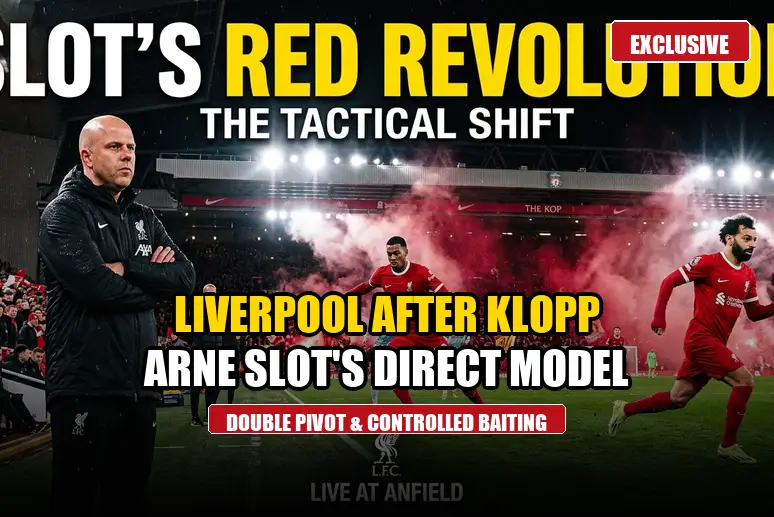
When Jürgen Klopp concluded his transformative nine-year reign at Anfield, European football commentators questioned whether Liverpool’s identity could survive without his signature "heavy metal" football. For nearly a decade, Liverpool was defined by chaotic counter-pressing, frantic end-to-end game states, and relentless physical intimidation. Entering the 2026/27 campaign under Arne Slot, however, Liverpool has executed one of the most successful tactical transitions in modern Premier League history. Rather than abandoning Liverpool's vertical roots, Slot has refined them into a mathematically controlled, direct transition model.
By replacing emotional chaos with tactical patience, Liverpool under Slot maintains the explosive counter-attacking firepower of the Klopp era while dramatically reducing the defensive vulnerability and physical exhaustion that plagued previous campaigns.
1. From "Heavy Metal" to Measured Control: The Philosophical Shift
Jürgen Klopp’s tactical ethos was anchored in the famous maxim that counter-pressing was the best playmaker in the world. Klopp's teams committed massive numbers forward, relying on instant counter-pressing swarms to win possession in the final third. While devastating at its peak, this high-octane methodology carried severe tactical costs:
- Open-Field Exposure: When an opponent successfully bypassed Liverpool’s initial pressing wave, Liverpool’s back four was left stranded in vast swathes of open turf.
- Match-Control Deficits: High-tempo chaos inevitably invited end-to-end basketball-style game states, leaving matches vulnerable to late swings in momentum.
- Accumulated Physical Attrition: Demanding 120 kilometers of collective high-intensity running per fixture led to recurring mid-season hamstring crises.
Arne Slot’s structural intervention was to replace constant pressing with "controlled baiting." Instead of chasing the opponent up to their 18-yard box, Liverpool in 2026/27 invites opposition pressure into their own half, drawing the opposing lines forward before triggering rapid vertical releases into space.
2. The Midfield Double-Pivot: Gravenberch and Mac Allister’s Spatial Mastery
The tactical linchpin of Slot’s Liverpool is the double pivot formed by Ryan Gravenberch and Alexis Mac Allister in a fluid 4-2-3-1 structure. In previous years, Liverpool deployed a lone defensive anchor (the traditional No. 6) flanked by two aggressive box-to-box runners who pushed high into the half-spaces.
Slot’s double pivot operates with sophisticated spatial discipline:
- Press Resistance in Deep Zones: Both Gravenberch and Mac Allister possess exceptional 360-degree awareness and technical agility under pressure. When Virgil van Dijk or Alisson Becker is closed down, the double pivot provides immediate, close passing outlets.
- The Turn and Accelerate Trigger: Gravenberch’s signature progressive carrying ability allows him to receive the ball with an opponent on his back, drop a shoulder, and surge into the middle third through the center circle.
- Rest-Defense Screen: By permanently maintaining two holding midfielders in front of the center-backs, Liverpool forms a solid 4-2 defensive rest-defense foundation. If an attacking move breaks down, the central channel is completely fortified.
Liverpool Buildup Phase (Baiting the Press):
     [Alisson]
[Konaté]   [Van Dijk]
  [Gravenberch]   [Mac Allister]  <-- Opponent presses high
  --------------------------------- [Open Space in Middle 3rd]
[Szoboszlai]
[Salah]       [Darwin/Jota]       [Diaz/Gakpo]
This setup lures aggressive Premier League pressing sides like Arsenal and Manchester City into overcommitting their midfield, creating the exact vertical runways that Liverpool’s explosive front line thrives upon.
3. Statistical Comparison: Klopp’s Peak vs. Slot’s 2026/27 Liverpool
The statistical evolution of Liverpool’s playing style highlights a dramatic increase in game management efficiency without sacrificing attacking punch.
| Tactical Metric | Klopp Era (2021–2024 Average) | Slot Era (2026/27 Campaign) | Tactical Assessment |
|---|---|---|---|
| Possession Share % | 61.8% | 58.4% | Slight reduction; intentional surrender of harmless possession to bait press |
| Direct Speed (Meters/Sec) | 1.75 m/s | 2.10 m/s | Higher vertical acceleration once transitions are initiated |
| xG Against from Fast Breaks /90 | 0.38 | 0.14 | 63% reduction in high-danger counter-attacking chances conceded |
| Turnovers Suffered in Own Half /90 | 9.8 | 6.1 | Superior deep composure and double-pivot technical security |
| Attacking Third Regains /90 | 14.2 | 9.8 | Fewer wild pressing traps; replaced by selective mid-block interceptions |
4. Attacking Transition Execution: The Front Four Synergy
Once the opposition press is broken, Liverpool’s attacking execution is surgical. Slot has organized the forward line into four defined transition outlets:
- Dominik Szoboszlai as the Transition Engine: Stationed in the 'No. 10' slot, Szoboszlai’s physical stamina allows him to lead the mid-block pressing triggers, then instantly sprint 40 yards to act as the primary passing link between the double pivot and the wingers.
- Mohamed Salah’s Playmaking Evolution: While Salah remains a lethal goal threat, his game in 2026/27 features extraordinary creative vision. Receiving on the right touchline with the opponent backpedaling, Salah uses outside-of-the-boot trivela passes to release the far-side winger into open space.
- Isolated 1v1 Flank Exploitation: With opposition full-backs caught upfield during failed presses, Luis Díaz or Cody Gakpo receives the ball in true 1v1 isolation with no covering center-back nearby, resulting in high-percentage cutback opportunities.
5. The Full-Back Dilemma: Inversion vs. Touchline Overlap
A crucial element of Arne Slot’s tactical refinement involves the calibrated deployment of Liverpool's full-backs. Under the previous regime, full-backs were tasked with relentless touchline overlaps, frequently operating as the team’s primary crossers while leaving massive acreage vulnerable to opposing wingers.
In the 2026/27 campaign, Slot has implemented an asymmetric full-back balance tailored to game state and opponent pressing schemes:
- The Inverted Anchor: On the right flank, Trent Alexander-Arnold (or Conor Bradley) frequently inverts into the central midfield line during initial buildup, creating a temporary 3-2-4-1 shape. This inversion provides Liverpool with an extra passing angle to break first-line pressure and frees Alexis Mac Allister to advance ten yards higher into the left half-space.
- The Delayed Touchline Burst: On the left flank, Andrew Robertson (or Milos Kerkez) no longer charges forward blindly on every possession. Instead, the left-back holds a conservative mid-line position until the ball is successfully shifted into the final third. Only when Luis Díaz or Cody Gakpo commits the opposing full-back does the overlapping run trigger, ensuring Liverpool maintains 3v2 defensive superiority behind the ball.
- Rest-Defense Structural Security: By staggering full-back advances, Liverpool consistently keeps four outfield players behind the ball during sustained attacking sequences. This prevents the catastrophic transition breaks that previously undermined title charges in late-winter fixtures.
6. Defensive Solidity: Van Dijk’s Controlled Command
Perhaps the greatest beneficiary of Arne Slot’s tactical restructuring is Virgil van Dijk. Under the chaotic counter-pressing of late-stage Klopp football, Van Dijk was frequently forced into emergency 1v1 recovery sprints against rapid wingers in transition.
Under Slot, the central channels are shielded by Gravenberch and Mac Allister, allowing Van Dijk and Ibrahima Konaté to defend within their preferred parameters:
- Dominating Aerial Duels: Opposition teams forced to play long clearances under pressure find Van Dijk winning 78% of his aerial battles, recycling possession effortlessly without breaking stride.
- Positional Depth: The defensive line does not hold an extreme high line in every situation; they drop intelligently when there is no immediate pressure on the ball-carrier, eliminating simple over-the-top passes into open grass.
- Channel Guidance: Rather than diving into risky tackles, Van Dijk uses his positioning to shepherd opposing counter-attackers toward the wide touchlines, buying crucial seconds for the double pivot to recover their defensive shape.
7. The Verdict: Sustainable Title Contention in 2026/27
Arne Slot has achieved what many thought impossible: modernizing Liverpool’s identity without stripping away the fierce emotional intensity that makes Anfield formidable.
By grounding Liverpool’s lethal vertical pace in a resilient double-pivot foundation, staggering full-back movements, and replacing frantic gegenpressing with calculated transition traps, Slot has forged a side perfectly engineered for the grinding marathon of the 2026/27 Premier League and Champions League campaigns. Liverpool has not merely moved on from Jürgen Klopp—they have systematically evolved into a more sustainable, tactically balanced footballing powerhouse.
