
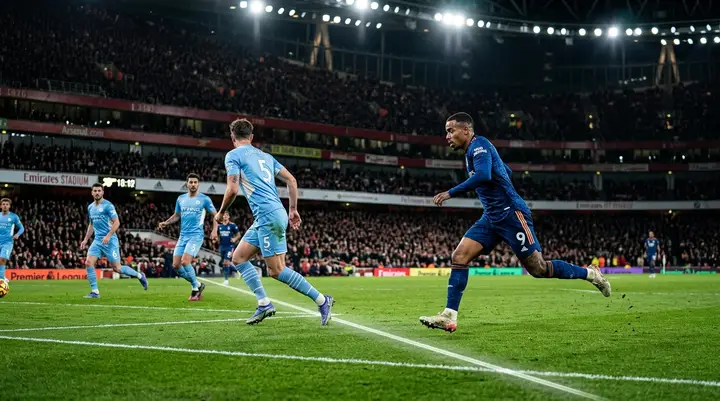
- Being in an offside position is not an offense by itself; you must actively interfere with play, an opponent, or gain an unfair advantage.
- Timing is everything: the offside check is frozen at the exact split-second the ball is struck by a teammate, not when you receive it.
- Mastering the line is an art form mastered by the sharpest penalty-box poachers, including the top 10 Premier League strikers by goals per game.
- Defenders resetting the offside phase must execute a "deliberate play" rather than an instinctive reaction save or wild deflection.
Every weekend, millions of fans scream at television screens across the globe over a thin yellow graphic. The offside rule remains the ultimate source of pub debates, tactical ingenuity, and sheer heartbreak. Yet when stripped of its dense legalese, the basic idea behind it is simple: prevent goal-hanging and force teams to outplay each other over the full pitch.
Even so, the modern game has introduced layers of complexity. Semi-automated technology, tricky subjective phrases like "deliberate play," and optical tracking cameras can leave casual viewers scratching their heads. Let's walk through the exact mechanics behind Law 11 and study five real-life examples that illustrate how it functions in real time.
The Foundations of Law 11: Position vs. Offense
First things first: standing in an offside position is completely legal. A player can spend an entire ninety minutes lounging near the corner flag if they like, provided they stay away from the action.
To be in an offside position, three conditions must exist simultaneously when the ball is played forward:
- Any part of the attacker's head, body, or feet is in the opponent's half of the pitch.
- That attacker is nearer to the opponents' goal line than both the ball and the second-to-last opponent.
- The player is actively engaged in the attacking phase.
Why do referees say "second-to-last opponent" instead of "the last defender"? Because the goalkeeper usually counts as the last opponent. If the keeper charges out into midfield, a field defender sitting on the goal line becomes the last opponent, and the keeper becomes the benchmark for offside.
The split-second threshold matters tremendously. The position is captured at the very moment the ball leaves a teammate's foot. Running past a defender after that pass is launched is perfectly fine.
When an Offside Position Becomes an Offense
So when does a referee actually blow the whistle? An offside player is penalized only if they become actively involved in the phase through one of three specific actions:
- Interfering with play: Touching or playing the ball passed or touched by a teammate.
- Interfering with an opponent: Preventing a defender or goalkeeper from playing the ball by blocking their line of vision, challenging them physically, or clearly attempting to distract them.
- Gaining an advantage: Scoring or creating a chance off a rebound from a goalpost, crossbar, or an opponent making an instinctive save or deflection.
| Scenario | Status | Why It Happens |
|---|---|---|
| Behind the Ball Line | Onside | If the attacker is level with or behind the ball when passed, position relative to defenders is irrelevant. |
| Goalkeeper Reflex Save | Offside Offense | Saves are instinctive reactions, not deliberate possession; rebounds to offside runners are whistled. |
| Defender Back-Pass Mistake | Onside | A deliberate back-pass from an opponent negates offside, allowing lurking attackers to capitalize. |
| Restart from Corner / Throw-in | Always Legal | Law 11 explicitly exempts goal kicks, corner kicks, and throw-ins from any offside rulings. |
Timing runs against a compact defensive line demands explosive acceleration and spatial awareness, dynamics we explored when comparing elite forwards in our breakdown of Haaland vs. Mbappé: Two Ways to Score.
5 Real-Life Examples Explained
Theory is nice, but real football creates chaotic situations that test the rules to their absolute limits. Let's look at five high-profile incidents that illustrate key offside principles.
1. Marcus Rashford & Bruno Fernandes vs. Manchester City (2023)
In the January 2023 Manchester derby, Casemiro slid an inviting through ball forward. Marcus Rashford was miles offside. He pursued the ball for thirty yards, hovering right over it without making physical contact, before Bruno Fernandes arrived from an onside position to sweep it past the keeper.
The goal was controversially awarded. Why? Under the exact wording at the time, Rashford didn't touch the ball, nor did he make physical contact with Manuel Akanji. However, this incident sparked huge backlash because Rashford's run clearly influenced the defender's positioning. The decision highlighted the razor-thin boundary between running toward a ball and legally interfering with an opponent.
2. Kylian Mbappé vs. Spain (2021 Nations League Final)
Kylian Mbappé was visibly standing in an offside pocket when receiving a forward pass against Spain. But as the ball traveled, Spanish defender Eric García stretched out a leg and grazed it with his studs, attempting to intercept.
Because García made a deliberate physical motion to touch the ball, officials deemed it a "deliberate play." Under the rules then, that touch instantly reset the phase and played Mbappé onside, leading to France's winning goal. The public outcry was so severe that IFAB updated their guidance shortly after, clarifying that an off-balance, stretching touch should count as a deflection rather than an intentional play.
3. Son Heung-min and Harry Kane's Square Passes
During their historic partnership at Tottenham Hotspur, Kane and Son repeatedly dismantled high defensive lines by breaking through and passing sideways. Frequently, Son was sprinting yards ahead of the opposing center-backs when Kane squared the ball to him for an open-net tap-in.
Yet these goals were consistently legal. Why? Because Son was positioned behind or level with the ball itself when Kane made the pass. When you are behind the ball, the position of the defensive line no longer matters.
4. The Trapped Goalkeeper: Netherlands vs. France (Euro 2024)
During Euro 2024, Xavi Simons hammered a loose ball into the French net, sparking wild Dutch celebrations. Seconds later, the assistant referee raised the flag. Dutch forward Denzel Dumfries was standing right next to French goalkeeper Mike Maignan in an offside position.
Dumfries never touched the ball. But by standing right in Maignan’s diving path, he physically and visually restricted the goalkeeper’s ability to dive for Simons' shot. Following an extensive VAR review, the goal was ruled out for interference.
5. Rebounds Off the Post and Reflex Saves
Imagine a striker drilling a shot from 25 yards out. A secondary attacker is standing in an offside position when the ball leaves the shooter’s foot. The shot smacks against the post, bounces out, and the offside attacker taps it into the net.
This is always offside. The rebound does not count as a deliberate opponent play. The attacker was in an offside spot when their teammate fired the shot and gained an advantage from that exact illegal positioning.
Frequently Asked Questions
Can a player be offside directly from a throw-in, corner, or goal kick?
No. Under IFAB Law 11, there is strictly no offside offense if an attacker receives the ball directly from a corner kick, throw-in, or goal kick.
Does an attacker's hand or arm count toward offside?
No. The hands and arms of all players are excluded when evaluating offside positions. Only body parts that can legally score a goal, such as feet, head, torso, and upper shoulders down to the bottom of the armpit, are considered.
What is the difference between a deliberate play and an accidental deflection?
A deliberate play occurs when a defender has clear control and makes an intentional action to pass or clear the ball. An accidental deflection or reflex save does not reset the offside phase, meaning an attacker in an offside position remains penalizable if they collect the rebound.
Can you be caught offside inside your own half of the pitch?
No. A player cannot be in an offside position while standing entirely within their own half of the field at the precise millisecond the ball is kicked by a teammate.
Explore Further on FootballPress
Understanding the nuances of pitch positioning helps illuminate tactical models. Take a deeper dive into analytics by reading what is xG and how expected goals work.