

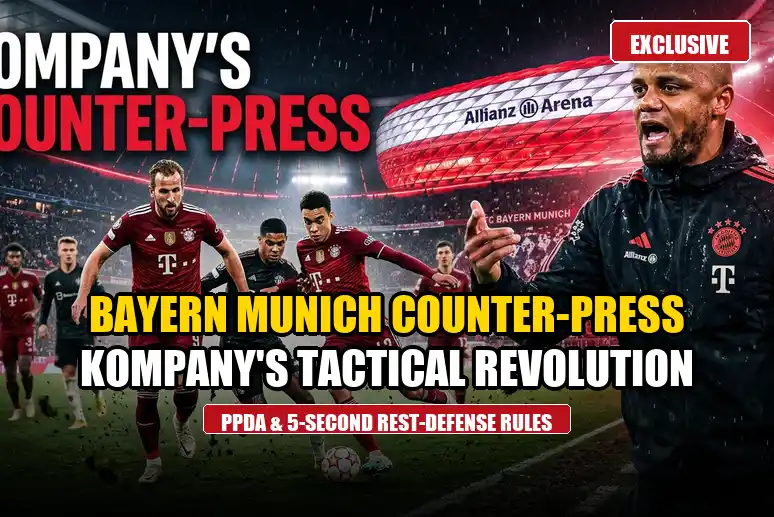
When Vincent Kompany was appointed to lead Bayern Munich, European football observers raised eyebrows at the hiring of a manager whose Burnley side had just suffered Premier League relegation. Yet tacticians inside the game understood the underlying philosophy: Kompany’s teams demand complete territorial dominance, an ultra-high defensive line, and relentless counter-pressing (gegenpressing) designed to asphyxiate opposition buildup. In the 2026/27 season, Bayern Munich has fully assimilated Kompany’s tactical framework, re-emerging as the most aggressive, high-leverage pressing machine in the UEFA Champions League.
Following several seasons characterized by passive mid-block transitions and defensive vulnerability against quick counters, Kompany has systematically rebuilt Bayern’s rest-defense and pressing triggers. The result is a team that defends by attacking forward, pinning elite European adversaries inside their own defensive third.
1. The High Defensive Line: Defending on the Halfway Line
The foundational prerequisite of Kompany’s counter-pressing structure is collective compression of pitch space. In the 2026/27 campaign, Bayern’s average defensive line height sits at an astounding 52.8 meters from their own goal line during sustained attacking sequences—the highest recorded mark among all 36 clubs in the Champions League league phase.
This extreme territorial push accomplishes two fundamental tactical aims:
- Eradicating Between-the-Lines Pockets: By pushing central defenders Dayot Upamecano and Min-jae Kim (or Hiroki Ito) to the center circle, the vertical distance between Bayern's forward line and back four is compressed to just 24 meters. Opposition playmakers are suffocated before they can turn.
- Immediate Anticipation Stepping: Rather than backpedaling when possession is contested, Bayern’s center-backs are instructed to step forward aggressively into the opponent’s half, engaging in direct physical aerial and ground duels the split-second a clearance is attempted.
Bayern Attacking Phase:
[GK: Neuer - 35m out]  ==>  [CBs: Upamecano / Kim - Halfway Line]
                                    \
       [Double Pivot: Kimmich / Pavlović - 10m into Opp. Half]
                                    \
         [Attacking Five: Olise - Kane - Musiala - Sané - Davies]
This high-wire act places extraordinary physical and cognitive demands on the center-backs, who must possess the recovery acceleration and timing to extinguish breakaways before they materialize into shots on target.
2. The Five-Second Rule: Zonal Swarming and Passing-Lane Traps
Counter-pressing is not merely chasing the ball wildly after a turnover; it is a calculated mathematical ambush. Under Kompany, Bayern operates with a synchronized "five-second rule" governed by spatial geometry and pre-set pressing triggers.
The moment Bayern loses possession in the final third:
- Immediate Ball-Carrier Harassment: The two nearest Bayern players (often Jamal Musiala and Michael Olise) sprint directly toward the ball-carrier, cutting off forward sightlines and forcing an instinctive, hurried pass.
- Shadow-Marking Escape Routes: The surrounding midfielders do not rush toward the ball; instead, they position themselves within the passing lanes to the opponent's full-backs and central pivots.
- The Trap Execution: The ball-carrier, blinded by immediate pressure, is forced into a lofted clearance or a risky central pass—precisely where Joshua Kimmich or Aleksandar Pavlović waits to intercept and recycle possession.
By suffocating opponents within five seconds of a turnover, Bayern avoids having to run 60 yards back toward their own penalty box, transforming defensive actions directly into immediate, high-xG scoring opportunities.
3. Statistical Evolution: Bayern Munich Under Kompany vs. Previous Seasons
The structural transformation under Vincent Kompany is reflected in Bayern’s core territorial and defensive metrics between the 2023/24 season and the current 2026/27 campaign.
| Tactical Metric | 2023/24 (Pre-Kompany) | 2026/27 (Kompany Blueprint) | Tactical Significance |
|---|---|---|---|
| PPDA (Passes Allowed Per Def. Action) | 11.4 | 7.8 | Steep increase in pressing intensity; forces quickest errors in Europe |
| High Turnovers Won /90 | 8.2 | 13.6 | Nearly 14 possessions won within 40m of opponent's goal per match |
| Defensive Line Height (Metres) | 44.1m | 52.8m | Pins opposition deep, suffocating counter-attacking transitions |
| xG Against from Counter-Attacks /90 | 0.48 | 0.21 | Rest-defense structure prevents clean through-balls |
| Harry Kane Open-Play Key Passes /90 | 1.45 | 2.38 | Kane operates as a deep playmaking false-nine facilitator |
4. Harry Kane’s Deep Role: The Playmaking Catalyst
A successful pressing team must possess the clinical efficiency to convert high turnovers into goals before the opponent can reorganize. For Bayern, Harry Kane is the tactical fulcrum that links counter-pressing to goal output.
Rather than remaining pinned against central defenders as an isolated target striker, Kane routinely drops into the midfield circle during transitions. This movement unlocks Kompany’s wide inside-forwards:
- Wing Infiltration: As Kane drops deep, wingers Michael Olise and Leroy Sané (or Mathys Tel) initiate diagonal sprints behind the opposition's defensive line, attacking the space vacated by Kane's marker.
- Musiala’s Half-Space Synergy: Jamal Musiala functions as an elusive interior playmaker, receiving Kane’s first-time progressive flicks and using his elite dribbling agility to break through central mid-blocks.
- Clinical Finishing from Second Wave: Kane does not stay deep; once he orchestrates the wide penetration, he arrives at the edge of the penalty box for cutbacks, producing exceptional shooting efficiency.
5. Champions League Stress Tests: Mitigating High-Line Vulnerabilities
While Kompany’s aggressive setup demolishes domestic Bundesliga mid-blocks, the true crucible of this tactical philosophy is the UEFA Champions League knockout rounds against transitional juggernauts like Real Madrid, Arsenal, and Manchester City.
Elite European sides possess wingers capable of exploiting the 50 yards of space behind Bayern’s backline. Kompany has implemented two critical countermeasures:
- Manuel Neuer’s Sweeper-Keeper Renaissance: Neuer operates as a true third central defender, sweeping loose through-balls up to 35 meters away from his goal line. His anticipatory timing extinguishes long balls before opposing sprinters can establish control.
- Tactical Fouling in Middle Third: If Bayern’s initial counter-press is breached, the double-pivot (Kimmich and Pavlović) commits disciplined, tactical obstruction fouls in the middle third before the opponent can execute a final line-breaking pass.
6. Conclusion: The Return of Bavarian Dominance
Vincent Kompany’s counter-pressing overhaul at Bayern Munich is more than an adjustment in running distance; it is a complete philosophical realignment with modern positional intensity.
By pushing defensive lines to the halfway mark, executing synchronized five-second pressing swarms, and utilizing Harry Kane as an elite transition conductor, Bayern has built a system tailored for Champions League glory in 2026/27. While the tactical risks of the high line remain real, the statistical rewards—overwhelming territorial control and defensive suffocation—have firmly re-established Bayern Munich among Europe’s most feared tactical sides.
