
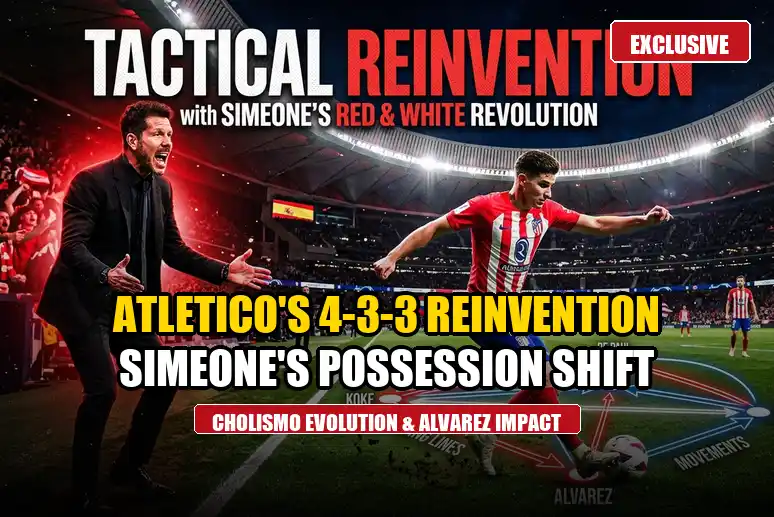
For over a decade, Diego Simeone’s Atlético Madrid was universally recognized as the antithesis of modern possession football. "Cholismo" became synonymous with an impenetrable 4-4-2 low block, cynical defensive game-state management, and lightning counter-attacks launched through direct aerial channels. Atlético delighted in suffering without the ball, conceding possession while choking off central shooting corridors. However, as La Liga opponents adapted by refusing to overcommit numbers forward, Atlético frequently dropped costly points against domestic low blocks. In recent seasons, Simeone has steered a profound tactical evolution, moving Atlético towards a more expansive, possession-based approach.
This tactical evolution is not an abandonment of Simeone’s fierce competitive DNA; rather, it is a modernized recalibration designed to dominate both the ball and the territory against contemporary European opposition.
1. The Death of the Low Block: Why Cholismo Had to Evolve
Between 2013 and 2021, Atlético’s compact 4-4-2 was Europe’s most effective defensive weapon. Two disciplined banks of four squeezed the vertical space between the lines, forcing opponents to circulate the ball harmlessly on the perimeter before losing aerial duels to Diego Godín or Stefan Savić.
By the mid-2020s, however, several tactical shifts rendered this approach obsolete in La Liga:
- Domestic Opponents Parked the Bus: Mid-table Spanish teams realized that attacking Atlético played into Simeone's hands. Opponents began conceding possession to Atleti, retreating into passive 5-4-1 shells that Atlético’s direct counter-attacking personnel lacked the technical nuance to penetrate.
- The Draw Penalty: Dropping points in 0-0 and 1-1 stalemates against low blocks systematically derailed title challenges against high-scoring Barcelona and Real Madrid sides.
- Modernized Recruitment: The signings of technically gifted, high-tempo conductors like Julián Alvarez, Conor Gallagher, and Pablo Barrios demanded an attacking framework that maximized their ball-dominant qualities rather than forcing them into endless defensive tracking.
Simeone recognized that to remain a perennial title contender and continental force, Atlético needed to control matches with the ball, not merely without it.
2. Structural Architecture: The 4-3-3 Positional Rotation
In the 2026/27 season, Atlético sets up nominally in a 4-3-3, which smoothly reorganizes into a fluid 3-2-5 attacking structure during sustained possession.
Atleti 3-2-5 Attacking Structure:
[Le Normand]          [Giménez]          [Reinildo/Azpilicueta]
          [Koke/Barrios]       [De Paul]
[Molina/Llorente]  [Gallagher]   [Alvarez]   [Griezmann]  [Lino]
The key operational mechanics include:
- The Inverted Flank Asymmetry: Left-back Samuel Lino pushes high onto the touchline as a true left winger, pinning the opposing right-back deep. This allows right-back Nahuel Molina (or Marcos Llorente) to step into the midfield line or make late overlapping runs, while the remaining three defenders form a stable rest-defense backline.
- The Double Creative Interior: Rodrigo De Paul and Pablo Barrios operate as the tempo controllers. Rather than smashing long balls over the top, they circulate possession patiently through the central channels, accumulating sustained territorial pressure and waiting for defensive seams to open.
- Rest-Defense Counter-Pressing: When possession is lost in the attacking third, Atlético does not retreat 60 yards into their own box. Instead, Simeone’s trademark aggression is deployed forward. The three forwards and two interior midfielders immediately swarm the ball-carrier, suffocating transitions within four seconds.
3. Julián Alvarez as the Tactical Catalyst
The focal point of Atlético’s attacking modernization is Argentine forward Julián Alvarez. Unlike classic Atlético target forwards who relied on physical hold-up play (such as Diego Costa or Mario Mandžukić), Alvarez operates with dynamic spatial intelligence.
Alvarez provides three vital tactical dimensions:
- Dropping to Create Midfield Overloads: When opposing center-backs attempt to maintain a compact defensive line, Alvarez drops ten yards into the 'No. 10' pocket. This creates a 4v3 numerical overload alongside De Paul, Barrios, and Antoine Griezmann, enabling intricate one-touch passing sequences.
- First-Line Defensive Harassment: Alvarez is Europe’s most relentless pressing forward. His willingness to close down goalkeepers and cut off central passing lanes triggers Atlético’s high pressing sequences.
- Channel Darting: When Griezmann drifts wide to deliver service, Alvarez makes explosive diagonal runs across the front post, converting cutbacks and low crosses with clinical accuracy.
4. Balancing Grit with Fluidity: European Knockout Applications
While domestic success requires breaking down stubborn low blocks, the true litmus test of Atlético’s 4-3-3 is the UEFA Champions League.
Against possession-heavy European giants like Manchester City or Bayern Munich, Simeone’s tactical setup exhibits chameleonic adaptability. Atlético does not foolishly dominate possession if the tactical game state dictates otherwise. Instead, the 4-3-3 seamlessly contracts into a 4-5-1 mid-block when required, utilizing Barrios and Gallagher’s defensive work rate to seal the central half-spaces before springing rapid vertical breaks through Alvarez and Lino.
This balance between contemporary positional possession and historical defensive grit makes Atlético uniquely resilient in two-legged knockout ties.
5. Conclusion: The Master Tactician’s Ultimate Evolution
Diego Simeone’s legacy in modern football has often been unfairly reduced to tactical conservatism and defensive shithousery. Yet his transformation of Atlético Madrid in the 2026/27 campaign demonstrates an elite manager capable of continuous structural reinvention.
By transitioning from a reactive 4-4-2 low block into a more aggressive, possession-based side, Simeone has equipped Atlético to dismantle La Liga mid-blocks while retaining the fierce defensive intensity that defines the club's soul. In the modern era of European football, Atlético Madrid proves that a club can evolve its tactical identity without losing its warrior heart.