
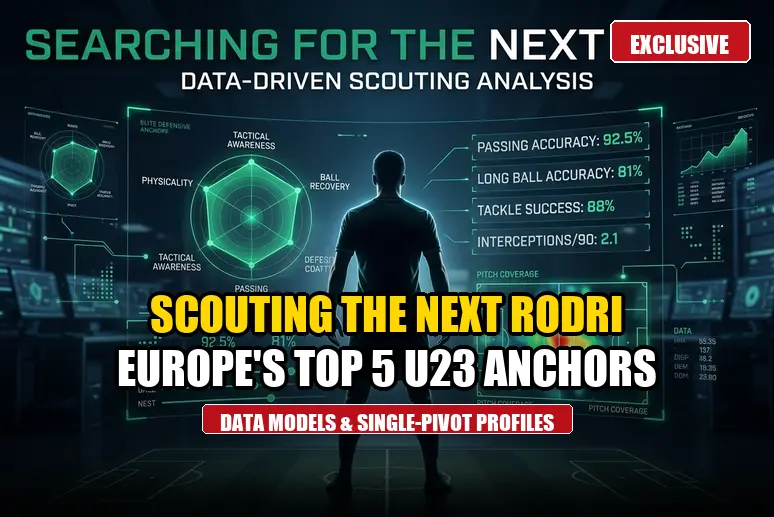
When Manchester City midfielder Rodri was awarded the Ballon d'Or following his European Championship triumph with Spain, it marked a historic paradigm shift in football analytics. For decades, individual honors were reserved almost exclusively for prolific goal-scorers and flashy dribblers. Rodri’s coronation formally recognized what recruitment analysts have long understood: the modern defensive midfield anchor (the single pivot 'No. 6') is the single most influential position in elite European football.
A world-class single pivot must perform an almost impossible dual mandate: acting as the team's primary build-up conductor (dictating tempo, absorbing pressure, and breaking lines) while simultaneously serving as the primary defensive shield (extinguishing counter-attacks, dominating aerial duels, and screening the back four). Finding a player capable of executing both roles at an elite level is the holy grail of modern scouting.
In the 2026/27 campaign, European sporting directors are scouring data models to identify the next generational anchor. Using advanced tracking metrics, we have analyzed Europe’s top five defensive midfield conductors under the age of 23.
1. The Rodri Blueprint: What to Look For
To evaluate prospective candidates, we first isolate the statistical signature that defines Rodri’s archetype at Manchester City:
- Press-Resistant Retention: Keeping the ball reliably under direct opponent pressure.
- Progressive Volume: Moving the ball forward regularly without conceding cheap turnovers in central zones.
- Central Defensive Ground & Air Dominance: Winning ground and aerial duels to neutralize target-forward clearances.
- Spatial Anticipation: Winning the ball through positional anticipation rather than reckless slide tackles.
Players who excel in only one facet—such as pure ball-winners who cannot pass under pressure, or graceful passers who become defensive liabilities in physical transitions—inevitably fail in single-pivot systems.
2. In-Depth Scouting Profiles
Aleksandar Pavlović (Bayern Munich)
- Archetype: Positional Regista with Tactical Maturity.
- Scouting Breakdown: Pavlović represents the closest stylistic match to Rodri’s spatial intelligence. Operating in Vincent Kompany’s high-line system, the German international demonstrates immaculate body orientation when receiving from center-backs. His composure under pressure invites comparison with Rodri. He dictates tempo effortlessly and possesses an exceptional range of diagonal switches.
- Development Area: Aerial duels. Physical, direct sides can target Pavlović on long goal-kicks.
João Neves (Paris Saint-Germain)
- Archetype: Dynamic Press-Resistant Ball-Winner.
- Scouting Breakdown: Neves is a relentless physical engine who combines South American ground aggression with Portuguese technical precision. Neves is a ferocious counter-pressing monster who covers ground with astonishing speed.
- Development Area: Positional discipline. Because of his natural instinct to hunt the ball, Neves occasionally vacates the central pocket, requiring a disciplined double-pivot partner rather than thriving as a lone single anchor.
Carlos Baleba (Manchester United)
- Archetype: High-Power Ball-Carrying Destroyer.
- Scouting Breakdown: Baleba possesses the most explosive physical profile in European midfield scouting. He dominates the transition phase through raw athletic power, driving forward with the ball through midfield. When breaking through first-line pressure, opponents bounce off his frame.
- Development Area: Final-third passing refinement. His passing under pressure is less secure than the others’, with occasional lapses in composure against elite presses.
Marc Bernal (Barcelona)
- Archetype: La Masia Single-Pivot Prodigy.
- Scouting Breakdown: Despite his youth, Bernal exhibits the natural geometric awareness of Sergio Busquets combined with modern physical size. He rarely loses the ball, reflecting extraordinary cognitive processing. He rarely requires more than two touches to redirect the entire flow of an attacking sequence.
- Development Area: Physical conditioning and top-end sprint recovery over 50 meters following major knee recovery.
Arthur Vermeeren (Royal Antwerp, on loan from RB Leipzig)
- Archetype: Spatial Connector and Half-Turn Conductor.
- Scouting Breakdown: Vermeeren thrives in systems that demand rapid vertical transitions. His reading of opposition passing lanes makes him an exceptional midfield interceptor, while his first-touch distribution breaks mid-blocks with clean efficiency.
- Development Area: Upper-body strength in contested static duels against physical Premier League-style target forwards.
3. Tactical Suitability: Lone Pivot vs. Double Pivot
Recruitment teams must recognize that not all defensive anchors can survive in a solitary single-pivot system:
Lone Single Pivot (Rodri / Pavlović / Bernal):
       [CB]               [CB]
                 [No. 6]  <-- Requires 360-degree awareness & low turnovers
         [No. 8]         [No. 8]

Double Pivot (Neves / Baleba / Vermeeren):
       [CB]               [CB]
            [No. 6]    [No. 6]  <-- Shared defensive & carrying responsibilities
For clubs like Manchester City, Real Madrid, or Arsenal that utilize a 4-3-3 with lone anchors, Aleksandar Pavlović and Marc Bernal represent the two most natural tactical successors to Rodri. For sides employing aggressive transitional 4-2-3-1 structures like Liverpool, Bayern Munich, or PSG, João Neves and Carlos Baleba offer superior dynamic range.
4. The Verdict: Who Inherits the Crown?
Replicating Rodri’s singular impact is an enormous task, but the data indicates that European football’s midfield pipeline is extraordinarily rich.
If a sporting director requires a plug-and-play single pivot capable of commanding 100 touches per match while suffocating central space, Aleksandar Pavlović and Marc Bernal are the clear statistical heirs. As the 2026/27 season concludes and elite clubs prepare their summer recruitment strategies, these five anchors will command record valuations as the indispensable tactical keystones of European football.