
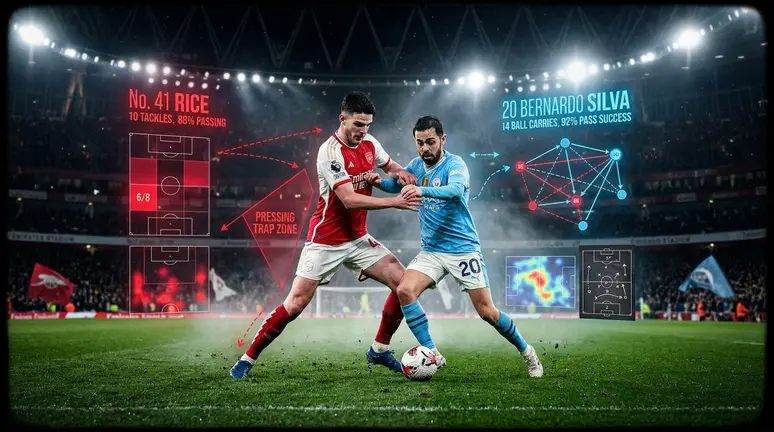
Arsenal vs Manchester City has evolved into modern European football's ultimate strategic stalemate. In 2026/27, Arsenal neutralizes City’s rotational 3-2-5 build-up through a hyper-physical 3-2 rest defense and duel-dominant double pivot, restricting City to low-quality peripheral shots (0.08 xG/shot) while exploiting near-post set-piece routines for decisive incremental margins.
The modern tactical rivalry between Mikel Arteta’s Arsenal and Pep Guardiola’s Manchester City represents the apex of structural football. What began as a philosophical master-apprentice dynamic has matured into a hyper-calculated game of millimeters. In the 2026/27 Premier League campaign, the clashes between these two sides are no longer defined by chaotic open-field end-to-end exchanges; instead, they are won and lost in the spatial dynamics of midfield overloads, rest defense positioning, and marginal expected goals (xG) efficiency.
As tactical systems across Europe trend toward synchronized pressing and structural rigidity, Arsenal and City operate on the cutting edge of spatial control. Understanding how Arteta and Guardiola counteract each other requires analyzing their central overloads, defensive rest architectures, and underlying analytical metrics.
1. Midfield Overloads: The 3-2-5 vs 4-2-3-1 Spatial War
At the heart of the Arsenal vs Manchester City matchup is the battle for central numerical superiority. When Manchester City possess the ball, they morph seamlessly from their nominal 4-3-3 shape into a fluid 3-2-5 structure. Typically, this involves an inverted full-back or central defender stepping up into the double pivot alongside the primary defensive anchor, creating a two-man central screen that pins the opposition's first line of pressing.
Against most Premier League opposition, City’s 3-2-5 overloads the half-spaces. Playmakers operate between the lines in Zone 14, manipulating full-backs and generating free-man passing angles for direct service into Erling Haaland.
However, Arsenal's counter-strategy under Arteta has nullified this overload with remarkable discipline:
- The Mid-Block 4-4-2 Funnel: Rather than aggressively pressing City's center-backs in high territory, Arsenal drop into a compact, narrow 4-4-2 mid-block. Martin Ødegaard joins Kai Havertz in the front two, screening passes into the double pivot rather than pressing the ball carrier.
- Double Pivot Lateral Covering: Behind the front pressing screen, Arsenal's central pairing maintains short horizontal spacing (rarely more than 12–14 meters apart). This forces City to play wide to their wingers, away from high-value central passing lanes.
- Aggressive Jumping Center-Backs: When City attempt to bypass the midfield wall with sharp vertical passes into dropping attackers, Arsenal’s center-backs aggressively jump forward into midfield to contest the first touch, refusing to allow City’s creators to turn facing forward.
Arsenal Defensive Shape vs Man City Possession:
[City GK & Back-3]
         ↓
   (Havertz)   (Ødegaard)      <-- Arsenal 1st Pressing Screen (Blocks central lane)
         ↓
 (Rice)         (Midfield 2)   <-- Compact Central Pivot (12-14m horizontal gap)
         ↓
[Saliba]       [Gabriel]       <-- Aggressive Jump Line to contest Zone 14
2. Rest Defense Architecture: Why Counter-Attacks Die Early
In elite tactical football, rest defense describes a team’s defensive structure while they are actively attacking. It is the tactical insurance policy designed to prevent counter-attacks the instant possession is lost.
In Arsenal vs Manchester City encounters, rest defense is the single largest factor controlling game state:
Arsenal’s 3-2 Rest Defense Paradigm
When Arsenal attack, their full-backs do not both push forward to overlap. Instead, one full-back tucks inside adjacent to the defensive midfielder, creating a 3-2 staggered rest defense behind the attacking five. If possession is turned over in the final third, Arsenal have five players situated in the central corridor within 30 meters of the ball. This structure enables immediate counter-pressing, forcing City into backwards passes or hurried clearances before Kevin De Bruyne or Bernardo Silva can launch transition passes to runners.
City’s Spatial Spacing and Counter-Pressing Traps
Manchester City deploy a variable rest defense that balances caution with high territory. Guardiola’s rest defense relies heavily on high line compression: City’s center-backs push up to the center circle, squeezing the vertical playing space down to approximately 28 meters.
While this compression allows City to sustain relentless territorial pressure (often maintaining 65%+ field tilt), it carries calculated risk. Arsenal have increasingly targeted the spatial pockets behind City’s high line using direct diagonals toward Bukayo Saka and rapid channel runs, forcing City’s recovering defenders into high-speed footraces toward their own goal.
3. Data Breakdown: Tactical & Expected Goals (xG) Comparison
To understand how these tactical philosophies translate into measurable performance, examining underlying 2026/27 campaign metrics reveals the distinct profiles of both sides:
| Metric Category | Arsenal (Per 90) | Manchester City (Per 90) | Tactical Implication |
|---|---|---|---|
| Expected Goals (xG) Created | 1.94 | 2.18 | City generate slightly higher cumulative box threat |
| Expected Goals Against (xGA) | 0.74 | 0.88 | Arsenal hold Europe's most resilient defensive baseline |
| xG Per Shot Conceded | 0.076 | 0.098 | Arsenal force lower-percentage, contested attempts |
| Passes Per Defensive Action (PPDA) | 10.4 | 9.1 | City press higher; Arsenal favor structured mid-block shape |
| Set-Piece xG Contribution (%) | 34.2% | 19.8% | Arsenal possess a massive dead-ball advantage via Nicolas Jover |
| Rest Defense Transition Denial (%) | 78.5% | 72.1% | Arsenal's backline snuffs out counter-attacks more reliably |
| Data Source: Opta / StatsBomb / FBref tracking metrics (2026/27 campaign). Rest Defense Denial measures % of opposition counter-attacks stopped before penetrating final third. | |||
4. The Decisive Margin: Set-Piece Supremacy
When two elite sides cancel each other out in open play, dead-ball situations become the deciding tactical battleground.
Arsenal's set-piece architecture, orchestrated by specialist coach Nicolas Jover, has turned dead-ball scenarios into an unmatched attacking weapon. In head-to-head clashes against Manchester City, Arsenal exploit City’s hybrid zonal marking system through several defined routines:
- The Goalkeeper Box Pin: Arsenal crowd the six-yard box, positioning tall physical presences directly in front of City's goalkeeper to impede clean claims and punch trajectories.
- Near-Post Flick Traps: By clustering five runners at the penalty spot before breaking in opposite directions, Arsenal isolate City’s zonal markers at the near post. One designated runner attacks the near post to flick the ball across goal, where back-post overloads finish into vacated space.
- Rest-Defense Protection on Corners: Rather than committing eight players into the box, Arsenal leave two elite duel winners outside the penalty arc. This prevents City’s rapid transition outlets from breaking away cleanly following clearances.
City, by contrast, rely on short-corner overloads designed to shift defensive blocks horizontally before crossing toward Erling Haaland at the far post. However, Arsenal's aerial dominance in Gabriel Magalhães and William Saliba renders cross-heavy attacks remarkably inefficient.
5. Strategic Outlook for the Title Race
As the 2026/27 title race intensifies, Arsenal vs Manchester City remains football's most sophisticated tactical laboratory. While City maintain a slight edge in territorial dominance and raw shot creation volume, Arsenal have built the premier defensive infrastructure in world football.
By combining an impenetrable 3-2 rest defense with set-piece precision and relentless duel winning, Arteta’s side has turned the tactical tables on Guardiola. The champion of this rivalry is no longer decided by artistic flair; it is determined by who commands the half-spaces and executes under the ruthless mathematics of expected goals.
Frequently Asked Questions (FAQ)
How does Arsenal's midfield structure neutralize Manchester City's 3-2-5 system?
Arsenal deploy a narrow 4-4-2 mid-block where Martin Ødegaard and Kai Havertz screen the central passing lanes into City's double pivot. Behind them, Arsenal's double pivot maintains tight horizontal spacing (12–14 meters), forcing City's build-up into wide, non-threatening areas while center-backs aggressively jump into Zone 14 to deny central turns.
What is rest defense and why does it decide Arsenal vs Man City matches?
Rest defense is the structural organization of defensive players while a team is attacking. In Arsenal vs Manchester City, rest defense determines how quickly counter-attacks are stopped. Arsenal deploy a 3-2 rest defense structure that keeps five central defenders and midfielders positioned within 30 meters of the ball, stopping 78.5% of counter-attacks before they reach the final third.
What do underlying xG metrics reveal about Arsenal vs Manchester City in 2026/27?
While Manchester City generate higher total expected goals (2.18 xG/90 vs 1.94 xG/90), Arsenal boast the superior defensive baseline, conceding just 0.74 xGA per 90 with an exceptionally low 0.076 xG per shot conceded. Furthermore, over 34% of Arsenal's expected goal threat comes from set-piece routines, representing their primary margin of victory.