
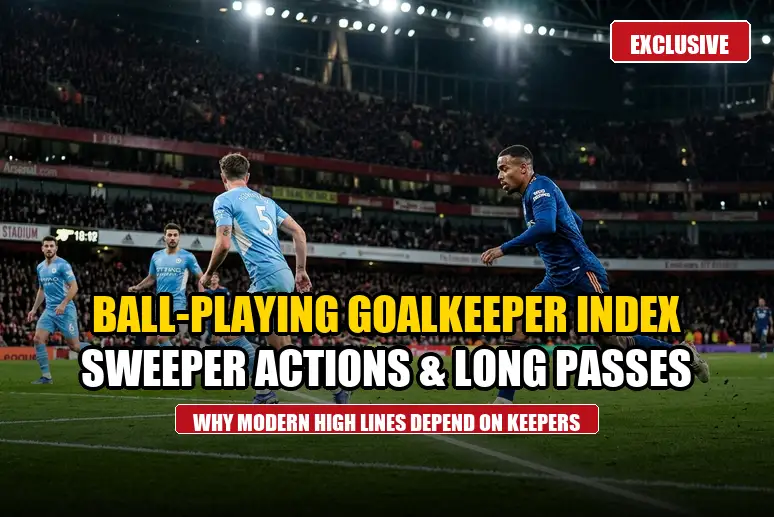
For more than a century of tactical development, the evaluation of goalkeepers was uncomplicated: could a player stop the ball from entering the net? Traditional scouting metrics revolved almost entirely around save percentages, clean sheets, and reflex diving agility. In the contemporary tactical era, however, shot-stopping represents merely the baseline threshold for top-flight employment. In the 2026/27 season, elite European clubs treat the goalkeeper as an active eleventh outfield player—a deep build-up playmaker in possession and an auxiliary sweeper-defender without the ball.
As European powerhouses like Manchester City, Arsenal, Barcelona, and Bayern Munich push their defensive lines to the halfway circle, the goalkeeper’s spatial footprint has expanded radically. A modern No. 1 must possess the ice-cold composure to invite high pressing inside their own six-yard box, the passing range to hit long, flat passes into the path of breaking wingers, and the anticipatory bravery to extinguish transitions far from their goal line.
To evaluate this multidimensional role, we have constructed the Ball-Playing Goalkeeper Index (BPGI), benchmarking Europe’s premier keepers across four core data pillars during the 2026/27 campaign.
1. The Four Pillars of a Ball-Playing Goalkeeper
The modern goalkeeper cannot be evaluated through generic pass completion rates, as sideways five-yard rollouts artificially inflate passing statistics. Our analytical model isolates four high-leverage attributes:
- 1. Sweeper Aggression & Distance (OPA /90): The frequency of defensive actions outside the penalty area per 90 minutes and the average distance from the goal line of those actions. This measures a keeper’s capacity to support an ultra-high defensive line.
- 2. Press-Bypassing Launch Value: The completion percentage and volume of passes exceeding 30 meters that land in the opposition half. Rather than aimless clearances, these are calibrated attacking passes designed to isolate wingers 1v1.
- 3. Press-Resistant Composure: Pass completion rate when closed down by an opponent within three meters. Keepers who panic and smash the ball out of play destroy possession control.
- 4. Shot-Stopping Foundation (PSxG +/- per 90): Post-Shot Expected Goals minus actual goals conceded. Modern distribution skills are worthless if a keeper leaks soft goals at their near post.
2. Dissecting the Elite Archetypes
Ederson: The Ultimate Deep Buildup Conductor
Ederson set the modern standard for goalkeeper distribution during his years at Manchester City, staying calm on the ball under intense pressure.
- The Flat-Trajectory Launch: Traditional goalkeepers kick long balls with high loft, giving opposition center-backs ample time to track the flight and win the header. Ederson strikes long passes with a low, flat trajectory that reaches runners before defenders can recover, landing softly on the chest of running wingers.
- Eliminating the Press: When opponents commit four players to press City’s 3-2 buildup, Ederson steps out of his six-yard box, creating an instant 6v4 numerical superiority. Opponents must choose between backing off or leaving Erling Haaland isolated in a 50-yard footrace.
Ederson Laser Transition:
[Ederson inside 6-yard box] === Low 60m trajectory ===> [Winger in full stride]
                             (Bypasses entire 10-man opponent press)
David Raya: Box Dominance and Sweeper Synchronization
David Raya’s value to Mikel Arteta’s Arsenal lies in how much space he covers, claiming crosses and sweeping behind a high defensive line. Arsenal kept six clean sheets in Raya’s first nine Premier League games of 2026/27.
- Suffocating the Space Behind Gabriel and Saliba: Arsenal can press high because Raya constantly positions himself well off his line. When opponents attempt desperate clearances into the channels, Raya sweeps up the danger before opposing forwards can sprint into contention.
- Mid-Range Distribution: Raya excels at clipping angled passes into the chests of full-backs or dropping attacking midfielders, allowing Arsenal to escape touchline pressing traps.
Manuel Neuer: The 35-Meter Sweeper Standard
Even in the veteran stage of his career, Manuel Neuer’s positioning under Vincent Kompany at Bayern Munich remains astonishing. Now 40, Neuer still routinely intercepts through-balls outside his own defensive third, acting as a third center-back during sustained territorial sieges.
Diogo Costa and Bart Verbruggen: The Modern Prodigies
- Diogo Costa (Porto): Combines elite long-range distribution with excellent shot-stopping, making him the most complete modern package in continental scouting.
- Bart Verbruggen: Specializes in "sole-of-the-boot" baiting. Standing completely still with the ball under his studs, Verbruggen draws opponent strikers to within two feet before clipping disguised reverse passes through the central channel.
3. Tactical Necessity: Why High Lines Die Without Sweeper Keepers
The tactical mathematics of modern football are unforgiving: a team cannot sustain a high defensive line without an elite sweeper-keeper.
- The 30-Meter Vacuum: If a defensive line pushes up to the 50-meter mark while their goalkeeper remains pinned inside their six-yard box, a 44-meter vacuum is created. Any mediocre clearance over the center-backs turns into a fatal 1v1 breakaway.
- Mental Freedom for Center-Backs: When defenders know their goalkeeper is actively reading through-balls, they can step forward aggressively to contest aerial duels and ground tackles without fear of being exposed by balls over their heads.
4. Conclusion: The Tactical Revolution is Irreversible
The modern goalkeeper has transcended the historical boundaries of their penalty box. In the 2026/27 season, success at the highest level of European competition requires a player who possesses the spatial intelligence of a central defender, the passing vision of a deep-lying playmaker, and the lightning reflexes of an elite shot-stopper.
Managers who continue to deploy traditional, goal-line-bound keepers find their tactical systems strangled by an inability to play out from the back or hold an aggressive territorial line. The Ball-Playing Goalkeeper Index proves that the number one shirt is now modern football’s ultimate strategic multiplier.